How Israel Found a 1-Mile Tunnel 270 Feet Inside Solid Rock
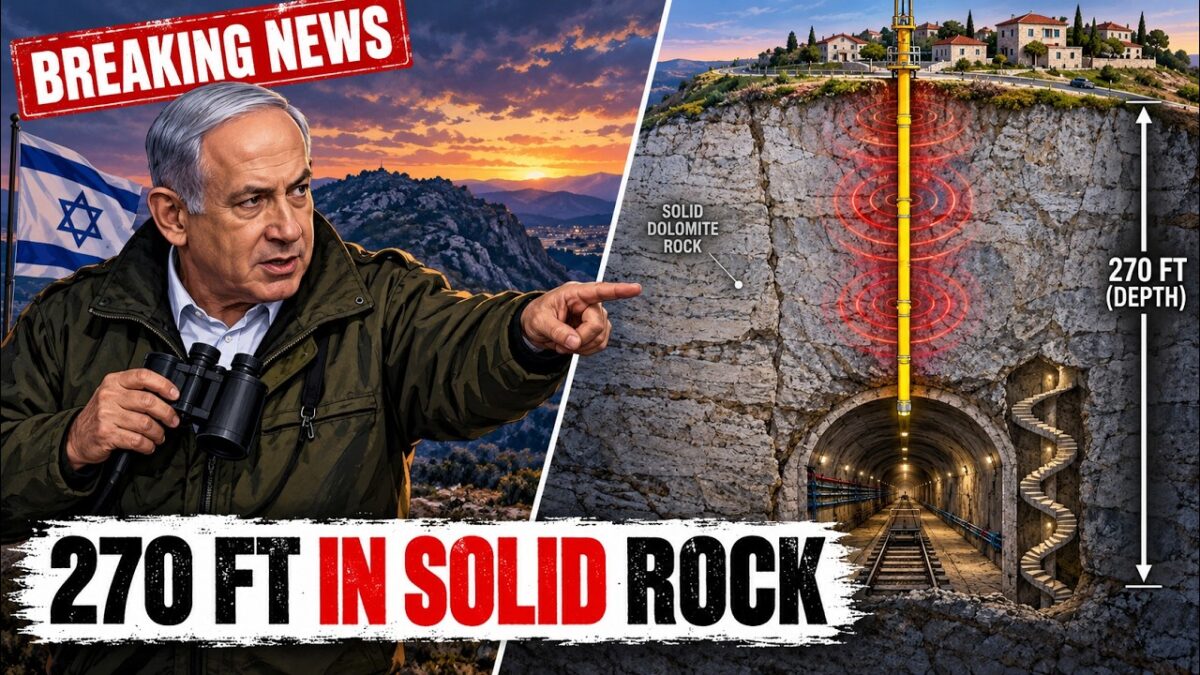
Directly beneath a quiet mountain village in northern Israel, 270 feet (80 meters) underground, a hidden corridor was inching forward in total darkness. That depth equals a 24-story skyscraper flipped upside down and buried in solid Cenomanian dolomite. The tunnel was wired with miniature rail tracks, high-voltage power cables and booster air pumps. It even had a 22-story rock-cut spiral stairwell.
This subterranean engineering duel raises three big questions:
- How do you carve a mile-long tunnel through 14,500-PSI rock without a Tunnel Boring Machine (TBM), and hide 15,000 metric tons of excavated stone from spy satellites?
- How do you locate a 6.5-foot-wide void buried under 270 feet of limestone, where Ground-Penetrating Radar (GPR) goes completely blind?
- Once engineers pierced the tunnel ceiling from above, why did they pump 10,000 tons of liquid bentonite-cement slurry into the mountain instead of using explosives?
This article breaks down the geology, mining physics, fiber-optic Distributed Acoustic Sensing (DAS), gyroscopic directional drilling and hydraulic concrete flooding behind Operation Northern Shield.
270 Feet Beneath a Sleeping Village
The story starts with scale. At 270 feet down, the tunnel sat far below the reach of ordinary surface surveys. Above it, life in the village went on as usual. Below it, a long and carefully engineered passage was advancing through rock that most excavation equipment would struggle to cut.
Gaza Sand vs. 14,500-PSI Dolomite Rock: The Natural Arch Trick
Tunnels in soft sand need heavy lining and constant support. Dolomite at around 14,500 PSI is a different material. Rock this strong can carry load on its own, so a tunnel cut through it can rely on a natural arch shape to stay open with minimal reinforcement. The geology made the tunnel possible. It also made it very hard to detect.
Digging in Secret: Pneumatic Drills, Chemical Splitters and 15,000 Tons of Mud
Without a TBM, excavation depends on pneumatic drills and chemical splitters that fracture rock quietly rather than blasting it. The spoil is the real problem. About 15,000 metric tons of excavated stone and mud had to be moved out and disguised, because piles of fresh rock are exactly what satellite imagery can reveal.
The Blind-Heading Trap: Breathing 3,300 Feet Inside a Sealed Straw
A tunnel advancing in one direction is a dead-end tube, and the far end is a “blind heading” with no natural airflow. At roughly 3,300 feet in, crews depended on booster air pumps to keep the working face breathable. Ventilation, power and rail haulage had to extend with every meter dug.
Turning a Mountain Into a Microphone: Fiber-Optic Acoustic Sensing
Ground-Penetrating Radar fails at this depth, so detection needed another approach. Distributed Acoustic Sensing sends laser pulses down a fiber-optic cable and reads tiny disturbances in the light that bounces back. Vibrations along the fiber change that signal, so the cable acts like thousands of microphones at once. Sound from drilling and digging deep in the rock could be picked up and mapped, which turned the whole mountain into a listening device.
The 270-Foot Needle in a Haystack: Gyroscopic Directional Drilling
Hearing the tunnel is not the same as hitting it. The tunnel is only about 6.5 feet wide, and the drill had to reach it from the surface through 270 feet of rock. Gyroscopic directional drilling lets engineers track and steer a drill bit underground without relying on magnetic sensors, which rock and steel can disturb. The result was a precise vertical approach to a very small target.
The Liquid Rock Flood: Why Engineers Pumped 10,000 Tons of Slurry Instead of TNT
Explosives can fracture surrounding rock and leave a weakened, unstable zone. Filling the tunnel with a bentonite-cement slurry avoids that. The mix flows into every gap, then hardens, permanently sealing the void. Engineers pumped around 10,000 tons of it into the mountain.
20 Million Pounds of Artificial Stone and the Ultimate Lesson
Where a hollow passage once ran, there is now roughly 20 million pounds of artificial stone. The wider lesson is that underground engineering contests are decided by geology, sensing technology and patience as much as by force.
Watch the Full Documentary
[Embed the YouTube video here: https://youtu.be/FrTRdLUGMK0]
Video Chapters:
- 0:00 270 Feet (24 Stories) Beneath a Sleeping Village
- 1:25 Gaza Sand vs. 14,500-PSI Dolomite Rock
- 4:30 Digging in Secret
- 6:30 The Blind-Heading Trap
- 8:15 Turning a Mountain Into a Microphone
- 11:50 The 270-Foot Needle in a Haystack
- 15:05 The Liquid Rock Flood
- 18:00 20 Million Pounds of Artificial Stone
Subscribe to Grand Structures for deep dives into extreme civil engineering, architectural physics and hidden megaprojects.
This is the story of the Israel tunnel 270 feet underground, and how engineers finally found it.
FAQ
How deep was the tunnel?
About 270 feet (80 meters) underground, roughly the height of a 24-story building.
Why couldn’t Ground-Penetrating Radar find it?
At this depth, GPR signals fade out in solid rock, so engineers used fiber-optic acoustic sensing and directional drilling instead.
Why use slurry instead of explosives?
Slurry fills the void completely without fracturing the surrounding rock.
Tags: Civil Engineering, Tunnel Engineering, Underground Engineering, Geotechnical Engineering, Megaprojects, Israel, Operation Northern Shield, Distributed Acoustic Sensing