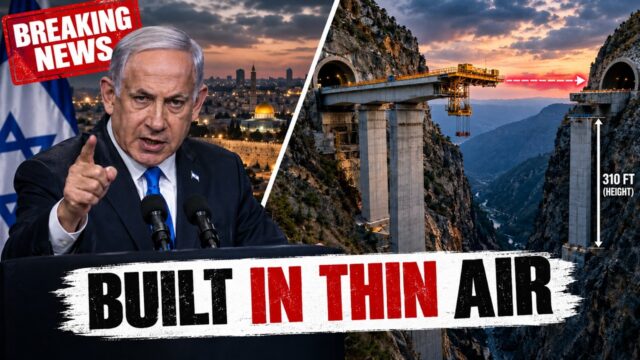
Electricity is hard to store. The power grid has to match supply and demand second by second — and when demand suddenly spikes, something has to respond almost instantly. Israel’s answer in the north of the country is a mountain that works like a giant rechargeable battery. In this Grand Structures documentary, we explain how the Gilboa pumped-storage power station turns water and gravity into 300 megawatts of on-demand power.
Watch the full documentary
Gilboa pumped storage at a glance
- Capacity: 300 MW (two 150 MW reversible units)
- Reservoirs: two, each holding about 2.5 million cubic meters of water
- Vertical shaft: about 500 meters (1,640 feet) deep
- Powerhouse: an underground cavern about 50 meters (164 feet) tall
- Cost: about $500 million; commercial operation began around 2020
- Location: Mount Gilboa, northern Israel
The problem with storing electricity
Power plants and solar farms produce electricity, but the grid itself has almost no storage. If demand rises faster than supply, frequency drops and blackouts can follow. As countries like Israel add more solar power — which peaks at midday and vanishes at night — the need for large-scale storage grows. Chemical batteries help, but they are expensive at grid scale and wear out over time.
Building a battery out of a mountain
Pumped-storage hydropower is the world’s most widely used form of large-scale energy storage. The idea is simple:
- When electricity is cheap and plentiful, pumps move water from a lower reservoir up to an upper reservoir.
- The water sits there, storing energy as gravitational potential energy.
- When the grid needs power, the water is released back down through turbines, generating electricity.
At Gilboa, the two reservoirs — each about 2.5 million cubic meters — are linked by a shaft roughly 500 meters deep and large pressure pipes. The bigger the height difference (the “head”), the more energy each cubic meter of water can store.
Letting gravity do the work: the 90-second drop
The plant’s key advantage is speed. Its reversible pump-turbines can switch from pumping uphill to generating downhill. According to the documentary, Gilboa can go from standby to injecting its full 300 megawatts into Israel’s grid in about 90 seconds — far faster than most conventional power plants can ramp up. That makes it ideal for covering sudden demand spikes or the loss of a large generator.
The 50-meter cavern underneath it all
Instead of building the powerhouse on the surface, engineers placed it inside an underground cavern about 50 meters tall, close to the bottom of the shaft. Locating the machinery deep underground keeps it close to the high-pressure water, protects it, and reduces the plant’s visual footprint on the landscape. The turbines and generators were supplied by Alstom (now part of GE), and the project was built by a partnership including Electra and Solel Boneh.
Why it matters for a whole country
Israel’s electricity grid is an “energy island”: it has very limited connections to neighboring countries’ grids, so it cannot easily import power during an emergency. That makes local storage and fast-response capacity especially valuable. Pumped storage helps Israel integrate more solar energy, stabilize grid frequency and keep the lights on during peaks — while lasting for decades with relatively low running costs.
The gravity battery idea
Gilboa is a reminder that some of the best “batteries” are not chemical at all. Wherever there is a suitable height difference and water, gravity can store energy at a scale few other technologies can match. Similar plants operate in the United States, including Virginia’s Bath County Pumped Storage Station, one of the largest in the world.
Frequently asked questions
What is pumped-storage hydropower?
A system that stores energy by pumping water to a higher reservoir when power is plentiful and releasing it through turbines to generate electricity when demand is high.
How much power does the Gilboa plant produce?
The Gilboa pumped-storage station has a capacity of 300 megawatts from two 150 MW reversible units.
Is pumped storage a renewable energy source?
It is a storage technology rather than a source; it uses electricity to pump water and returns most of it later. It helps grids use more renewable energy like solar and wind.
More megaprojects explained every week — subscribe to Grand Structures on YouTube.