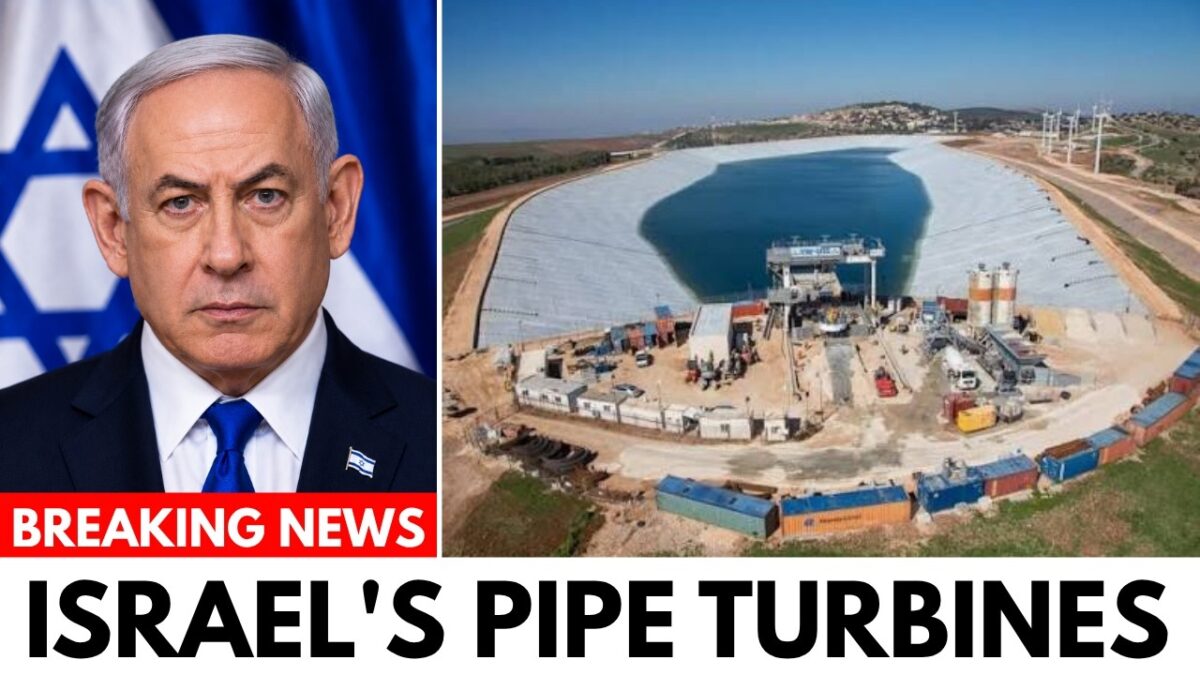
In the Bible, King David curses Mount Gilboa after the death of Saul: “Let there be no dew or rain upon you.” Three thousand years later, Israeli engineers turned that mountain into one of the most advanced energy storage facilities in the country — by filling it with water.
The Gilboa Pumped-Storage Plant drills a vertical shaft about 500 meters deep, deeper than the Empire State Building is tall, and carves a powerhouse cavern roughly 16 stories high inside solid stone. It works like a mechanical water battery, able to go from standby to powering about 200,000 homes in around 90 seconds. Here is how pumped storage hydropower works, and why it matters for clean energy everywhere.
Watch the Full Documentary
The Problem: Storing Electricity
Electricity grids must balance supply and demand every second. Solar power produces abundant energy at midday but none at night. Demand peaks in the evening. Without storage, excess solar power is wasted, and fossil plants must ramp up quickly when the sun sets. Israel, with almost no grid connections to neighbors, cannot import power to fill gaps.
How a Water Battery Works
Pumped storage uses two reservoirs at different heights. When electricity is cheap or abundant, pumps lift water from the lower reservoir to the upper one, storing energy as gravitational potential. When power is needed, water falls back down through turbines, generating electricity. The same machines act as pumps in one direction and turbines in the other.
At Gilboa, the upper reservoir sits on the mountain and the lower reservoir lies in the valley below, with the shaft and tunnels connecting them. Each reservoir holds millions of cubic meters of water — on the order of a billion gallons.
A Powerhouse Inside the Rock
The turbines and generators are housed in an underground cavern. Putting them deep inside the mountain reduces the visual impact, protects the equipment and provides the necessary pressure head at the turbine inlets. Excavating a cavern this large required careful rock engineering, including rock bolts, shotcrete and monitoring for movement.
Zero to Full Power in 90 Seconds
Unlike large thermal plants, which can take hours to start, pumped storage can respond almost instantly. That makes it ideal for stabilizing the grid when a large power plant trips offline or when solar output drops suddenly due to clouds. The plant’s roughly 300 megawatts of capacity provide fast backup across the national grid.
Private Financing
The Gilboa project was developed and financed privately under a long-term agreement with the state. Investors earn returns by providing capacity and storage services. It is an example of how energy storage is becoming a business, not just public infrastructure.
Key Facts at a Glance
- Location: Mount Gilboa, northern Israel
- Vertical shaft: about 500 meters deep
- Capacity: about 300 MW
- Response time: about 90 seconds
- Role: storing surplus solar and stabilizing the grid
Pumped Storage in America
The United States has dozens of pumped storage plants, including Bath County in Virginia, one of the largest in the world. As states add more solar and wind, new projects are being proposed across the West. Gilboa shows how the concept can fit into tight, mountainous terrain.
Frequently Asked Questions
Is pumped storage renewable?
It is a storage technology; it becomes “green” when charged with renewable electricity.
How efficient is pumped storage?
Typically around 70–85% round-trip efficiency.
Why not use lithium batteries?
Batteries are growing fast, but pumped storage offers very long life and large capacity.
Grand Structures explains the engineering, defense technology and megaprojects shaping the Middle East and the world. For more deep dives like this, subscribe to Grand Structures on YouTube.