The Strait of Hormuz is a narrow channel of water between Iran and Oman — and in 2026 it has become the most closely watched waterway on the planet. Before the Iran war, roughly one out of every five barrels of oil consumed worldwide passed through it. When traffic collapsed this year, oil prices jumped above $100 a barrel and American drivers felt it at the pump. Here is a simple guide to what the Strait of Hormuz is and why it matters so much.
Key facts
- Location: between Iran (north) and the Musandam Peninsula of Oman (south), linking the Persian Gulf to the Gulf of Oman and the Arabian Sea.
- Width: about 21 miles at its narrowest, with two shipping lanes each about 2 miles wide.
- Oil flow: about 21 million barrels per day in 2022 — roughly 21% of global petroleum consumption, according to the U.S. Energy Information Administration (EIA).
- LNG: around one-fifth of global liquefied natural gas trade, mostly from Qatar.
- Main buyers: Asia — China, India, Japan and South Korea took about two-thirds of the crude.
Where is the Strait of Hormuz?
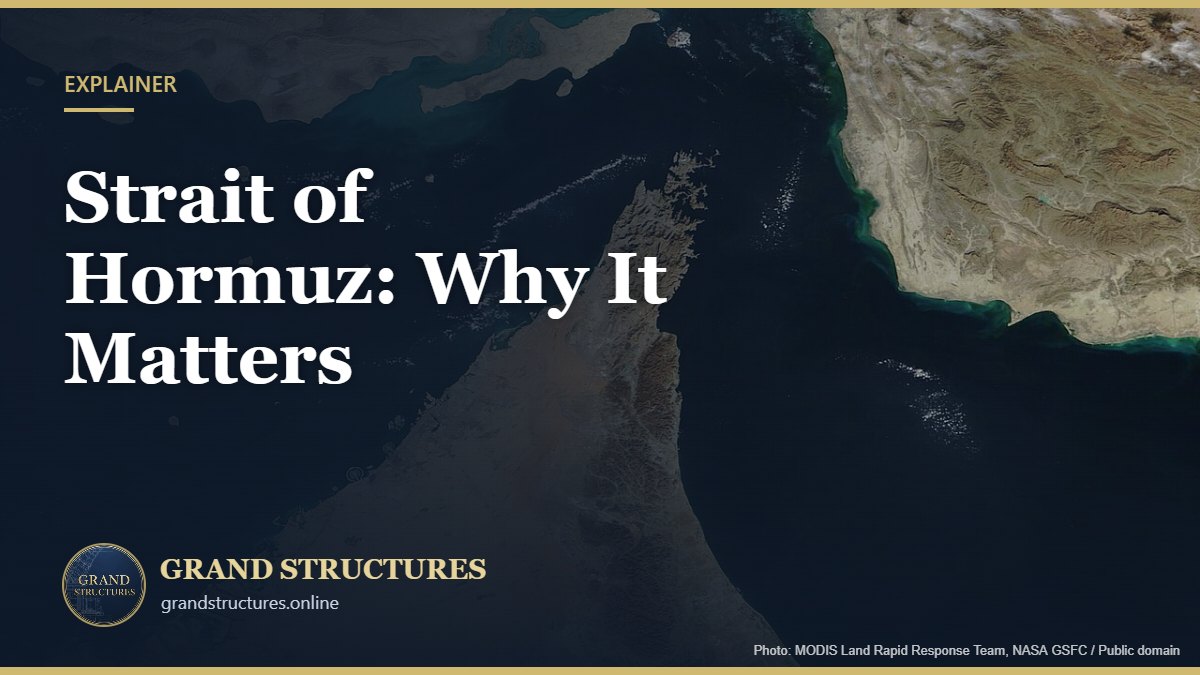
The strait sits at the mouth of the Persian Gulf. Iran controls the northern shore, including the port of Bandar Abbas and several islands. The southern shore belongs to Oman’s Musandam exclave, with the United Arab Emirates close by. Every tanker leaving Kuwait, Iraq’s Basra terminals, Qatar, Bahrain, and most Saudi and UAE ports must sail through it to reach the open ocean.
How shipping works in the strait
Ships follow a Traffic Separation Scheme: one lane inbound, one lane outbound, each about two miles wide, separated by a two-mile buffer. The channel is deep enough for the largest supertankers, which carry around 2 million barrels each. Because the lanes are so narrow, a handful of mines, drones or missiles can disrupt traffic for the entire world.
Why the Strait of Hormuz matters to the world
There is no other sea route out of the Gulf. Some oil can bypass the strait through pipelines — mainly Saudi Arabia’s East-West pipeline to the Red Sea and the UAE’s line to Fujairah — but before the war EIA estimated only about 3.5 million barrels per day of spare bypass capacity, a fraction of normal flows. Read more about the Saudi East-West pipeline.
Because oil is priced globally, any disruption raises prices everywhere — even in the United States, which imports relatively little Gulf oil. In 2022, U.S. imports from Persian Gulf countries were about 0.7 million barrels per day, around 11% of U.S. crude imports.
What happened to the strait in 2026?
After U.S. and Israeli strikes on Iran began on Feb. 28, 2026, Iran’s Revolutionary Guard warned ships away and declared the strait closed. War-risk insurance dried up, traffic collapsed and Brent crude crossed $100 for the first time in four years, peaking near $126. A short-lived agreement in June broke down in July. Since then, the U.S. has enforced a naval blockade of Iranian ports while Iran insists the strait stays closed until its conditions are met. (See: How the U.S. blockade of Iran works.)
Ships have been hit by drones, missiles and mines. By early October, the International Maritime Organization counted at least 93 vessels struck and 24 seafarers killed since February. Our report on the tanker war explains the risks crews face.
A long history of tension
This is not the first crisis in Hormuz. During the Iran–Iraq War in the 1980s, both sides attacked tankers in what became known as the “Tanker War,” and the U.S. Navy escorted reflagged Kuwaiti tankers. In 1988, after a U.S. frigate struck an Iranian mine, the U.S. launched Operation Praying Mantis against Iranian naval forces. Iran has threatened to close the strait many times since, but 2026 is the first time traffic has been shut down for months.
What it means for you
- Gas prices: The U.S. national average has stayed above $4 a gallon since late July. See why gas prices are so high.
- Inflation: Higher fuel and shipping costs ripple into airfares, groceries and goods.
- Markets: Any news of a deal to reopen the strait tends to push oil sharply lower; new attacks push it higher.
Frequently asked questions
Who controls the Strait of Hormuz?
No single country owns it. Iran and Oman have territorial waters on each side, and international law gives ships the right of transit passage. In practice, Iran’s military has used drones, missiles and mines to restrict traffic in 2026.
How wide is the Strait of Hormuz?
About 21 miles (33 km) at its narrowest point, with shipping lanes only about 2 miles wide in each direction.
How much oil goes through the Strait of Hormuz?
Before the war, about 20–21 million barrels per day, roughly one-fifth of global oil consumption.
Information current as of late October 2026.