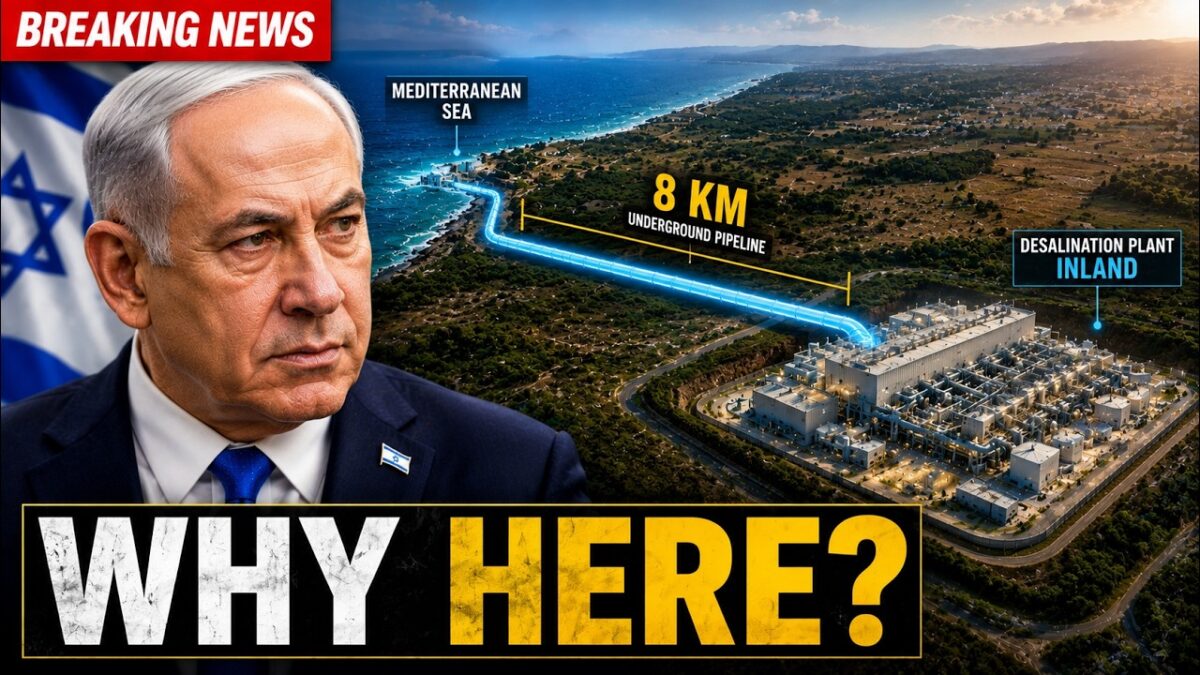
If your facility’s only job is to pull millions of gallons of water out of the ocean, the obvious place to build it is right on the beach. Yet when Israel built Sorek 2 — a mega-plant designed to produce about 200 million cubic meters of drinking water a year — it deliberately placed it several kilometers inland.
Moving away from the sea meant longer intake and outfall pipelines and more construction. But that apparent penalty helped engineers reduce the cost of water by roughly 30 percent compared with earlier plants. Here is why this Israel desalination plant broke the usual rules.
Watch the Full Documentary
Why Not Build on the Beach?
Israel’s Mediterranean coastline is short, crowded and valuable. Beachfront land is needed for cities, tourism, ports, nature reserves and military sites. Large industrial plants on the shore face opposition and high land costs. Building inland freed planners from those constraints and allowed a larger, more efficient site layout, next to existing infrastructure.
Gravity as a Pump
The inland site sits in a natural depression relative to its surroundings. Engineers used that geography so that parts of the water flow could move with the help of gravity rather than relying entirely on pumps. In a plant this large, even small savings in pumping head translate into significant energy reductions every hour of every day. Optimizing pipeline routes, elevations and diameters was as important as optimizing membranes.
Making Chemicals on Site
Desalination plants need chemicals to control biological growth in intakes and pipes, commonly chlorine-based compounds. Trucking and storing large quantities is costly and carries safety risks. Sorek 2 produces its own disinfectant through onsite electrochlorination, passing an electric current through salt water to generate sodium hypochlorite. Since the plant has an unlimited supply of seawater, it effectively makes its own bleach.
A Power Plant Next Door
Reverse osmosis consumes large amounts of energy. Sorek 2 is paired with a dedicated power plant of roughly 90 megawatts. Having generation on site reduces exposure to grid prices and transmission losses, allows steam or direct mechanical drives for pumps, and enables heat and byproduct integration. Carbon dioxide from the power plant exhaust can be captured and used in the remineralization stage, where minerals are added back to make the water stable and healthy.
Bigger and More Efficient Membranes
Like its predecessor Sorek, the new plant uses large-diameter pressure vessels holding reverse-osmosis membranes arranged vertically and efficient energy recovery devices that capture the pressure of outgoing brine. Scale itself drives down cost: fewer, larger units are cheaper to build and run per cubic meter.
The Price of Water
Thanks to these design choices, Sorek 2 bid one of the lowest prices for desalinated seawater ever recorded. For Israel, cheaper water means more affordable supply for homes, more reliable allocations for farmers and greater capacity to refill natural sources like the Sea of Galilee.
Key Facts at a Glance
- Plant: Sorek 2, south of Tel Aviv
- Capacity: about 200 million cubic meters per year
- Location: several kilometers inland
- Key features: gravity-assisted layout, onsite electrochlorination, dedicated ~90 MW power plant
- Result: water roughly 30% cheaper than earlier plants
Lessons for the United States
Coastal land in California is just as contested as in Israel, and proposed U.S. desalination plants have faced lengthy fights over shoreline sites. Sorek 2 shows that an inland plant with tunneled or piped intakes can reduce conflicts while staying cost-competitive.
Frequently Asked Questions
How does an inland plant get seawater?
Through large intake pipelines running from offshore intakes to the plant.
Where does the brine go?
Back to the sea through an outfall pipeline, diluted to protect marine life.
Is Sorek 2 the largest desalination plant in Israel?
It is among the largest seawater reverse-osmosis plants in the world.
Grand Structures explains the engineering, defense technology and megaprojects shaping the Middle East and the world. For more deep dives like this, subscribe to Grand Structures on YouTube.