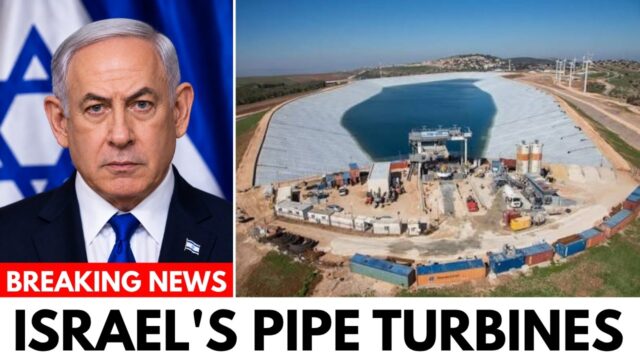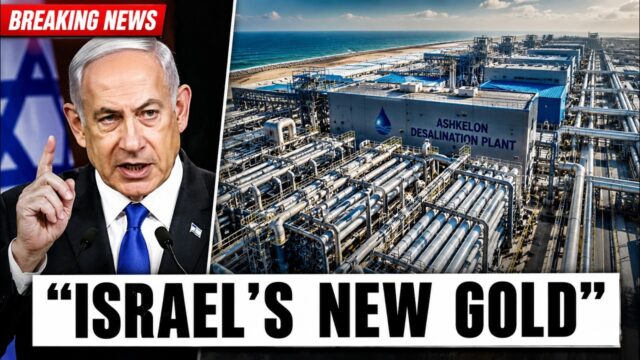
In 2000, many water engineers believed that turning the ocean into a national water supply was simply too expensive to be practical. Seawater desalination was a technology for oil-rich Gulf states and small islands, not for a country trying to keep its farms and cities alive on a budget. Then, in 2005, a massive facility on Israel’s southern coast came online and set a world record for the lowest price of desalinated seawater.
The Ashkelon desalination plant did more than make water. It helped shift the strategic balance of a region where water had long been a source of conflict, and it became one of the most important Israel water crisis solutions of the century.
Watch the Full Documentary
A Country Running Dry
By the early 2000s, Israel was overdrawing its aquifers and the Sea of Galilee was falling dangerously low after years of drought. Water allocations to farmers were cut, and the threat of saltwater intrusion into coastal groundwater was growing. Water also featured heavily in negotiations with neighbors, since the Jordan River basin and mountain aquifers are shared resources.
The Three-Center Design
Ashkelon was built by a consortium including IDE Technologies under a build-operate-transfer contract. One of its key innovations was a centralized layout often described as a “pressure center” or three-center design. Instead of building many separate trains, each with its own high-pressure pump and energy recovery system, the plant grouped high-pressure pumps, membrane racks and energy recovery units into large shared centers.
That arrangement allowed bigger, more efficient pumps, reduced piping and friction losses, and lowered capital costs. It also gave operators flexibility to run the plant at different outputs.
DWEER: A Mechanical Seesaw for Energy
The brine leaving reverse-osmosis membranes is still under very high pressure. Throwing that energy away would waste a large share of the plant’s electricity. Ashkelon used DWEER energy recovery devices — work exchangers with pistons and valves that transfer pressure from outgoing brine directly to incoming seawater, like a mechanical seesaw. The plant had one of the largest DWEER installations in the world, sharply cutting energy per cubic meter.
The Invisible Threat: Boron
Seawater contains boron, which standard reverse-osmosis membranes do not fully remove. At low concentrations it is harmless to people, but it is toxic to many crops, including citrus. Since much of Israel’s water ends up on farms, Ashkelon added a patented multi-stage process, adjusting the water’s pH so boron converts into a form membranes can reject more effectively. It was an unglamorous but essential innovation.
Financial Engineering
The roughly $250 million plant was privately financed. The operator agreed to sell water to the government at a fixed price for decades, and the government guaranteed to buy it. That long-term contract made the project bankable and drove relentless efficiency, since every saving improved the operator’s margins.
The Regional Impact
Ashkelon’s success led to a fleet of plants — Palmachim, Hadera, Sorek, Ashdod and Sorek 2. Within about 15 years, desalination supplied most of Israel’s household drinking water. Israel began selling water to Jordan and supplying additional water to the Palestinian Authority, turning water from a pure source of tension into an occasional tool of cooperation.
Key Facts at a Glance
- Opened: 2005, Ashkelon, southern Israel
- Cost: about $250 million
- Innovations: pressure center design, DWEER energy recovery, boron removal
- Impact: record-low desalination cost at the time
Why It Matters for the American West
As the Colorado River shrinks, U.S. states are considering large desalination plants. The Carlsbad plant near San Diego, the largest in the U.S., was built with IDE technology. Ashkelon’s lesson: efficiency, smart contracts and boron control make desalination affordable at scale.
Frequently Asked Questions
Is the Ashkelon plant still running?
Yes, and it has been expanded since opening.
What is DWEER?
A dual work exchanger energy recovery system that recycles brine pressure.
Why is boron a problem?
It can damage sensitive crops even at low levels.
Grand Structures explains the engineering, defense technology and megaprojects shaping the Middle East and the world. For more deep dives like this, subscribe to Grand Structures on YouTube.