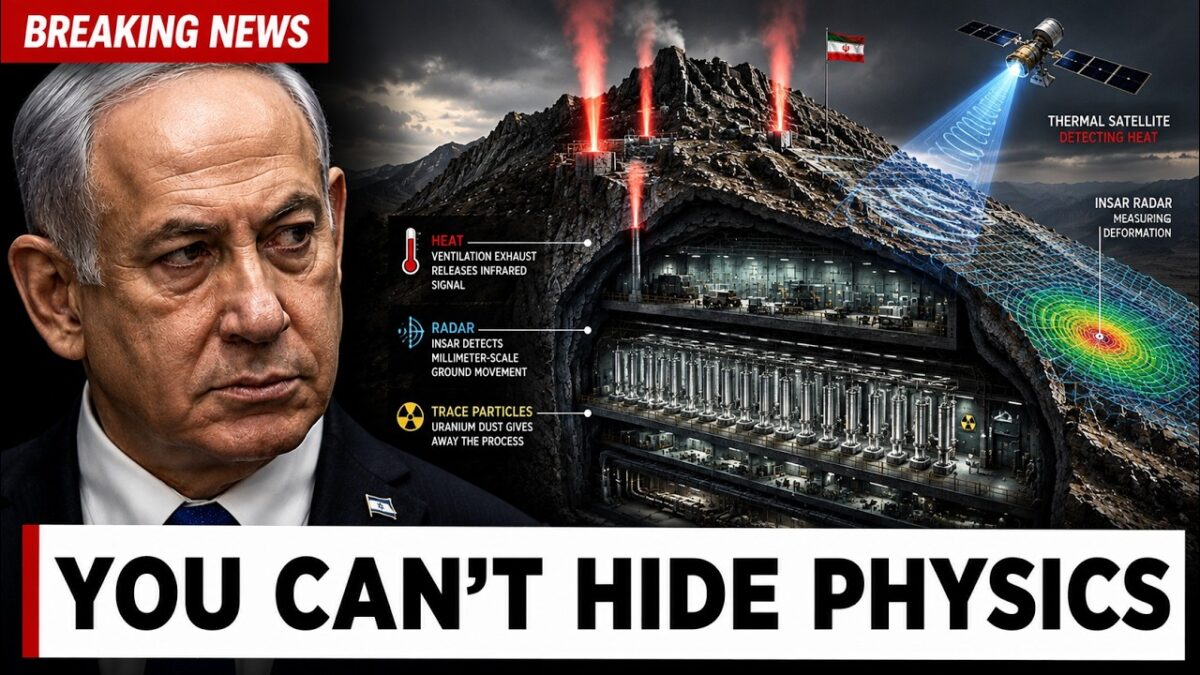
When Iran built its Fordow and Natanz nuclear facilities, it placed key halls deep underground — Fordow inside a mountain near Qom, under an estimated 80 to 90 meters of rock. The goal was to make them resistant to air strikes, including American bunker busters like the GBU-57. But while depth can stop a bomb, it cannot repeal the laws of physics.
Uranium enrichment is an industrial process on a massive scale, and industry leaves fingerprints. This article explains why an Iran nuclear facility is so hard to truly hide, and the scientific tools used to monitor it from orbit and on the ground.
Watch the Full Documentary
Why Enrichment Needs an Industrial City
Natural uranium is about 99.3% uranium-238 and only 0.7% uranium-235, the isotope that sustains a chain reaction. The two differ in mass by just three neutrons — about 1%. Separating them requires converting uranium into a gas, uranium hexafluoride, and spinning it in thousands of centrifuges at extreme speeds. Each centrifuge achieves only a tiny separation, so they are linked in long chains called cascades.
That means enrichment plants need huge halls, stable power, precise climate control, constant cooling and a steady flow of materials. They run continuously for years. Everything about them is big and persistent.
Heat From Orbit
Centrifuges, motors and electronics produce heat, which must be removed by ventilation and cooling systems. That heat reaches the surface through exhaust vents and cooling equipment. Thermal infrared satellites can detect warm exhaust, especially at night. Changes in heat output over time can hint at whether a facility is running, expanding or idle.
Why Seismic Sensors Struggle
It might seem that spinning centrifuges should vibrate enough to detect seismically. In practice, modern centrifuges are carefully balanced, mounted on dampers and buried in rock that absorbs high-frequency vibrations. Seismic sensors are far better at detecting explosions and large machinery than the subtle hum of an enrichment hall.
InSAR: Measuring the Mountain to the Millimeter
Radar satellites can measure tiny ground movements through interferometric synthetic aperture radar (InSAR). By comparing radar images taken at different times, analysts can detect surface deformation of just millimeters. Excavation, tunneling, heavy construction and even thermal expansion of the ground can show up. InSAR was widely used to assess damage and changes at Iranian sites after the 2025 strikes.
The Most Powerful Tool: A Cotton Swipe
The most sensitive detector is surprisingly low-tech. International Atomic Energy Agency inspectors wipe surfaces with cotton swabs and send them to laboratories. Mass spectrometry can identify individual particles of uranium and measure their isotopic composition. A single particle can reveal whether uranium has been enriched — and to what level. This is how inspectors detected uranium particles enriched close to 84% at Fordow in 2023.
Putting It Together
No single method gives a complete picture. Optical imagery tracks construction and vehicles. Thermal imagery reveals activity. InSAR measures ground changes. IAEA inspections provide ground truth when access is allowed. Intelligence sources fill the gaps. Combined, they make it extremely difficult to run a secret enrichment program for long.
Key Facts at a Glance
- Key sites: Fordow (near Qom) and Natanz
- Fordow depth: estimated 80–90 meters
- U-235 in natural uranium: about 0.7%
- Detection methods: thermal imagery, InSAR, IAEA environmental sampling
Why It Matters to the U.S.
U.S. policy toward Iran depends on knowing how much enriched uranium Iran has and where it is. After the 2025 strikes, debates over what survived — and where material may have been moved — rely on exactly these detection techniques.
Frequently Asked Questions
Can satellites see centrifuges?
No. They detect surface clues such as heat, construction and ground movement.
What enrichment level is needed for a bomb?
Weapons-grade uranium is generally around 90% U-235.
Why are IAEA swipes so important?
They can detect microscopic particles that reveal exactly what nuclear material has been present.
Grand Structures explains the engineering, defense technology and megaprojects shaping the Middle East and the world. For more deep dives like this, subscribe to Grand Structures on YouTube.