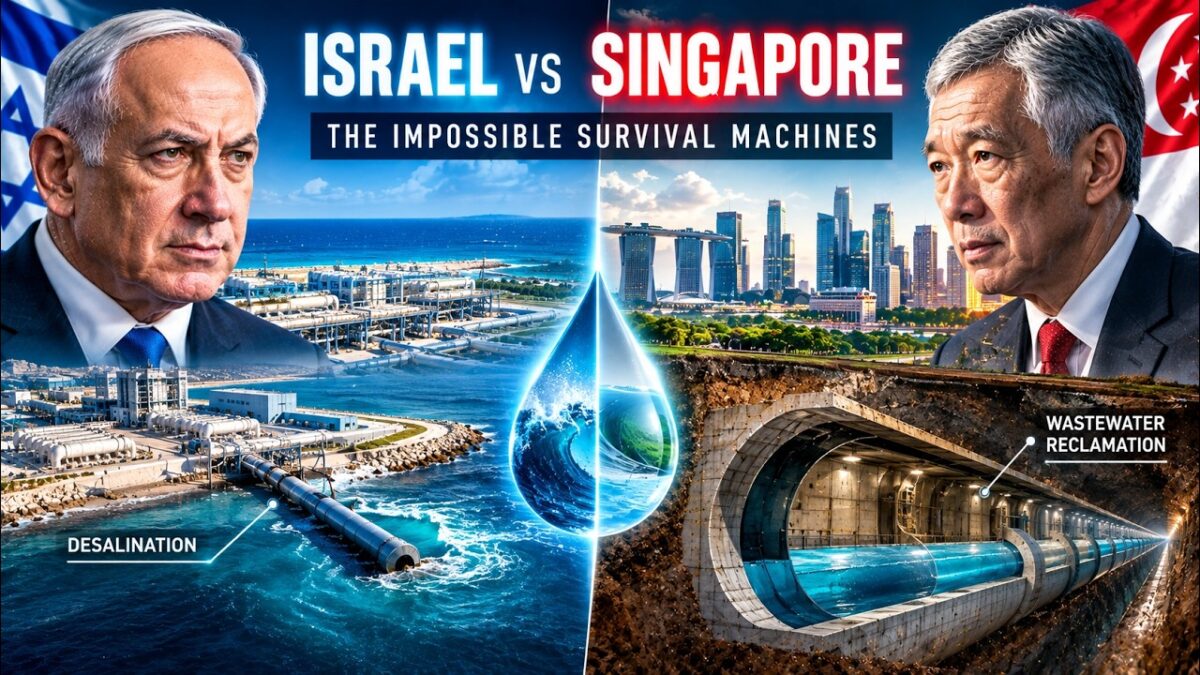
Israel and Singapore are among the most technologically advanced countries in the world — and both have struggled with the one resource money cannot simply print: fresh water. Singapore is a densely populated island with limited land to collect rain. Israel is mostly desert. To survive, each engineered a completely different solution.
Singapore built the Deep Tunnel Sewerage System, a gravity-driven network deep underground that feeds plants recycling wastewater into ultra-pure NEWater. Israel built giant seawater desalination plants like Sorek. Comparing the two reveals much about the future of global water security.
Watch the Full Documentary
Singapore’s Problem
Singapore historically depended heavily on water imported from Malaysia under long-term agreements. That dependence was a strategic vulnerability. The government set out to create “Four National Taps”: local catchment, imported water, desalination and recycled water. NEWater became the centerpiece.
The Deep Tunnel Sewerage System
Instead of pumping sewage through many small treatment plants, Singapore built a vast tunnel network, buried as deep as about 50 meters, that carries wastewater by gravity to a few large centralized plants. Deep tunnels free valuable land on the surface, reduce pumping and odors, and allow treatment to be concentrated where advanced technology can be applied efficiently.
Making NEWater
At the water reclamation plants, treated wastewater goes through microfiltration or ultrafiltration, reverse osmosis and ultraviolet disinfection. The result is ultra-clean water that exceeds drinking standards. Much of it goes to industry, especially semiconductor fabs that need extremely pure water, and some is added to reservoirs.
Israel’s Problem
Israel faced chronic drought, overpumped aquifers and a shrinking Sea of Galilee. Unlike Singapore, it had a long coastline and a vast sea next door. Its strategy became desalinating the Mediterranean at massive scale while also recycling nearly 90% of its wastewater for agriculture.
How Sorek Works
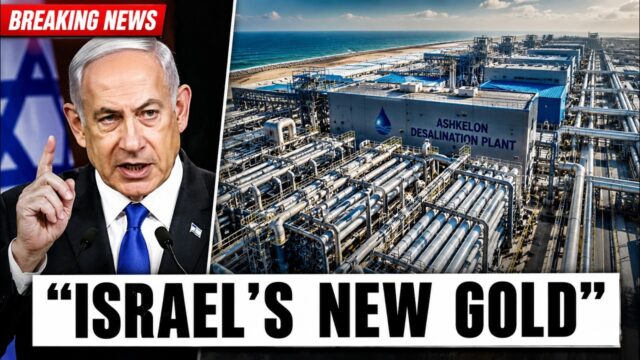
Sorek draws seawater through offshore intakes and pushes it through reverse-osmosis membranes in large vertical pressure vessels. Pressure exchangers recycle the energy from outgoing brine, keeping power use low. The plant produces around 600,000 cubic meters of drinking water a day.
Head to Head
- Source: Singapore recycles used water; Israel desalinates seawater.
- Energy: recycling wastewater typically needs less energy than desalinating seawater, because used water is far less salty.
- Public acceptance: NEWater required years of public education; desalinated water faced less resistance.
- Use: Israel’s recycled water mainly irrigates farms; Singapore’s NEWater mainly serves industry.
Geographical Traps
Each solution fits its geography. Singapore lacks space but has a compact, fully sewered city that makes centralized recycling efficient. Israel has abundant coastline and agriculture that can absorb treated wastewater. Neither model can be copied blindly elsewhere.
Lessons for the United States
Southern California is pursuing both paths: the Carlsbad desalination plant near San Diego and large potable reuse projects like Orange County’s Groundwater Replenishment System and Los Angeles’ Pure Water plans. Israel and Singapore show that the strongest systems use multiple sources, not just one.
Frequently Asked Questions
Is NEWater safe to drink?
Yes. It meets and exceeds drinking water standards.
Which uses more energy, desalination or recycling?
Seawater desalination generally uses more energy than recycling wastewater.
Does Israel drink recycled wastewater?
Mostly no. It is used primarily for agriculture.
Grand Structures explains the engineering, defense technology and megaprojects shaping the Middle East and the world. For more deep dives like this, subscribe to Grand Structures on YouTube.