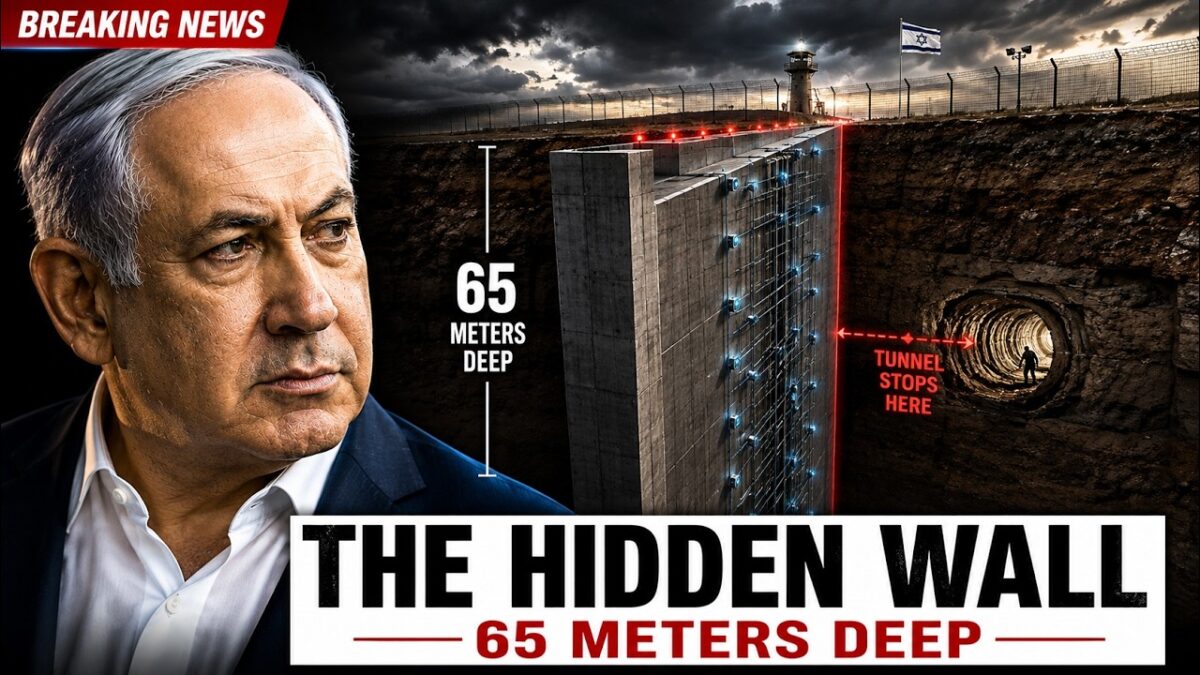
For decades, border security meant watching the surface with fences, cameras, drones and radar. But on the Gaza border, the most serious threat came from below. Militants dug cross-border attack tunnels tens of meters underground in total darkness, emerging inside Israeli territory. Surface sensors could not see them coming.
Israel’s response was one of the most unusual civil engineering projects in modern border security: a barrier that extends deep underground, often called the “underground Iron Dome.” Completed in 2021 after roughly three years of work, it runs about 65 kilometers along the Gaza border and reaches depths reported at up to 65 meters, using around two million cubic meters of concrete. Here is how it was built, how it detects tunnels, and why no underground wall is perfect — a central lesson of modern Israel tunnel warfare.
Watch the Full Documentary
Why Tunnels Were So Hard to Stop
Gaza’s soil is mostly sand, clay and soft sandstone called kurkar — easy to dig with hand tools and small machines. Tunnels can be reinforced with concrete segments and run for kilometers. On the surface, the only signs might be a hidden shaft inside a building. Detecting a narrow void 20 or 30 meters underground is extremely difficult with conventional radar, which loses signal quickly in wet or clay-rich soil.
Pouring a Wall Into a Trench That Shouldn’t Exist
The barrier uses a technique called a slurry wall, or diaphragm wall, common in deep city basements and subway stations. A specialized grab or hydromill cutter digs a narrow, deep trench in panels. As it digs, the trench is kept full of bentonite slurry — a dense clay-water mix whose pressure holds the walls open, preventing the sandy soil from collapsing.
Once a panel reaches full depth, a steel reinforcement cage is lowered in and concrete is pumped from the bottom up through a pipe called a tremie. The heavier concrete displaces the slurry upward. Panel by panel, this creates a continuous concrete wall far below ground. Building it across 65 kilometers required dedicated concrete plants along the border and round-the-clock work.
Listening for Shovels
The wall is not just a physical block. It is studded with sensors. Geophones and seismic sensors act as microphones for the earth, picking up vibrations from digging, drilling or hammering. The challenge is noise: traffic, farm machinery, wind and weather all produce vibrations. Artificial intelligence and signal processing filter out that background to isolate the rhythmic patterns typical of tunneling.
Above Ground, Too
On top of the underground barrier sits a smart fence about six meters high, with cameras, radar and command-and-control systems. A naval barrier extends the system into the sea.
The Honest Limits
No underground wall is truly perfect. Tunnels can, in theory, go deeper than the barrier, though that is much harder in Gaza’s geology. Sensors can miss quiet, slow work. And the barrier addresses only one threat. The October 7, 2023 attack, in which Hamas fighters breached the border above ground, showed that even the most advanced infrastructure can fail without the right intelligence, readiness and manpower.
Key Facts at a Glance
- Length: about 65 km along the Gaza border
- Depth: reported up to about 65 meters
- Concrete: roughly 2 million cubic meters
- Construction time: about three years, completed in 2021
- Technology: slurry walls, geophones, AI signal processing
Relevance to the U.S. Border
Smuggling tunnels have been discovered along the U.S.–Mexico border too, particularly near San Diego and Nogales. U.S. agencies have studied Israeli tunnel detection technology, and American funding has supported joint U.S.–Israel counter-tunnel research.
Frequently Asked Questions
How deep is the Gaza underground barrier?
Reports say it reaches depths of up to about 65 meters in places.
Did the barrier stop the tunnels?
It sharply reduced the cross-border tunnel threat, though tunnels inside Gaza remained extensive.
What is a slurry wall?
A concrete wall built in a deep trench held open by bentonite slurry, then filled from the bottom up.
Grand Structures explains the engineering, defense technology and megaprojects shaping the Middle East and the world. For more deep dives like this, subscribe to Grand Structures on YouTube.