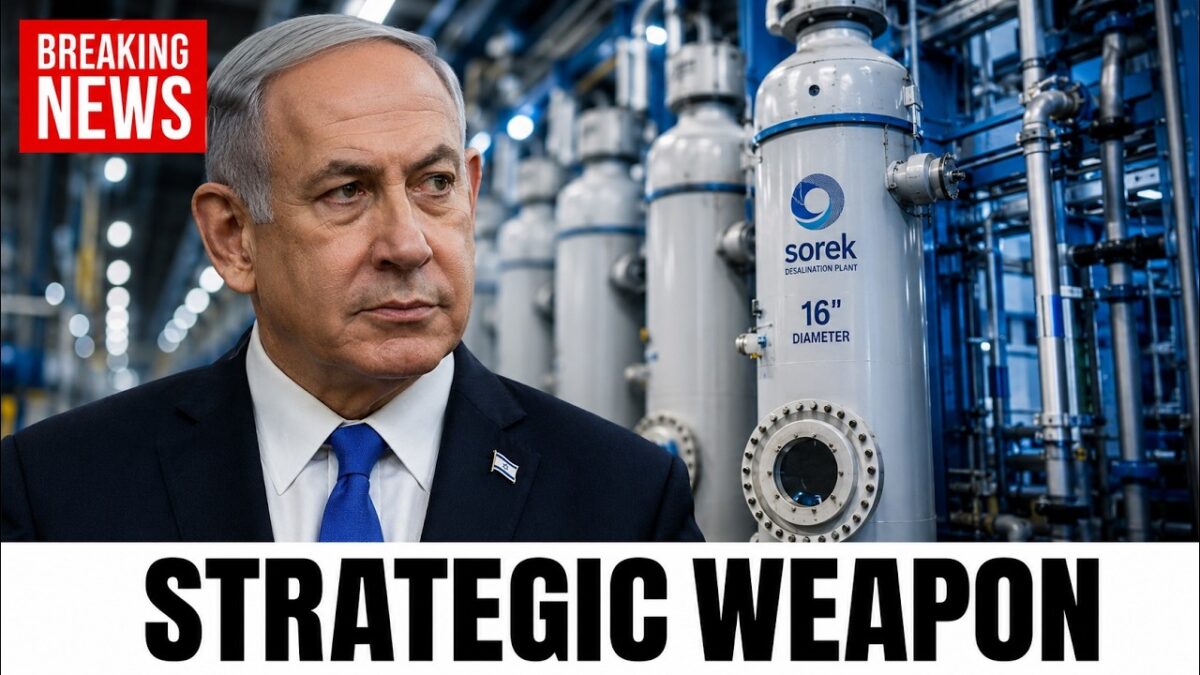
About 15 kilometers south of Tel Aviv stands the Sorek desalination plant, producing roughly 624,000 cubic meters of fresh water every day. That is enough for well over a million people. But turning the Mediterranean into drinking water is not just a filtering problem. It is an arm-wrestling match against a law of physics called osmotic pressure.
For decades, that thermodynamic wall meant that water scarcity could be used as leverage in the Middle East. By beating it cheaply and at scale, Israel turned a water factory into one of its most strategic assets. Here is the Israel desalination technology that made it possible.
Watch the Full Documentary
Nature’s Resistance: Osmotic Pressure
When fresh water and salt water are separated by a semi-permeable membrane, water naturally flows toward the salty side to equalize concentration. That push is osmotic pressure, and for seawater it is about 27 bar. To reverse the process — to squeeze fresh water out of seawater — you must apply more than that pressure. In practice, plants operate at around 60 to 70 bar to achieve good recovery. Pressure means energy, and energy means cost.
Standing the Membranes Up
Most desalination plants arrange membrane pressure vessels horizontally in long racks. Sorek, built by IDE Technologies, introduced 16-inch-diameter pressure vessels arranged vertically. Larger vessels hold more membrane area each, reducing the number of pipes, connections and fittings. Standing them upright dramatically shrinks the plant’s footprint and simplifies maintenance access — crucial on Israel’s expensive coastal land.
Recycling 90% of the Energy
About 55% of the seawater fed into membranes leaves as brine, still under nearly full pressure. Sorek uses rotary pressure exchangers — ceramic rotors spinning inside sleeves — that transfer brine pressure directly to incoming seawater with very high efficiency. They recover the vast majority of that energy, so the main pumps only need to make up the difference. This is one of the biggest reasons Sorek’s energy use per cubic meter is so low.
Trapping Boron With Chemistry
Boron passes through standard membranes because, at seawater’s natural pH, it exists mostly as an uncharged molecule. Raising the pH converts it into a charged borate ion that membranes reject far more effectively. Sorek uses multi-pass treatment with pH adjustment to bring boron below agricultural limits. It sounds like a minor detail, but without it, desalinated water would harm Israel’s citrus, avocado and other sensitive crops.
Why Water Is Strategy
Before desalination, Israel’s water supply depended on rainfall, the Sea of Galilee and shared aquifers — all vulnerable to drought and politics. Today, much of its drinking water comes from the sea, which no neighbor controls. That independence has allowed Israel to sell water to Jordan, expand supplies to Palestinian areas and refill natural sources. Water became a tool of cooperation as well as security.
The Vulnerabilities
Strategic assets attract threats. Desalination plants are large, fixed and coastal, making them potential targets for missiles and drones. They depend on electricity and can be disrupted by algae blooms or pollution. That is why Israel spreads production across several plants and keeps reserves in natural reservoirs.
Key Facts at a Glance
- Location: about 15 km south of Tel Aviv
- Output: about 624,000 m³ per day
- Key innovations: 16-inch vertical pressure vessels, pressure exchangers, boron removal
- Builder: IDE Technologies
A Model for American Cities
Sorek is often cited by U.S. officials studying desalination for California and Arizona. Its combination of compact design, energy recovery and long-term contracts offers a template as the American Southwest confronts a shrinking Colorado River.
Frequently Asked Questions
How much energy does Sorek use?
It is among the most energy-efficient large seawater plants, using roughly 3 kWh or less per cubic meter.
Is desalinated water healthy to drink?
Yes, after remineralization it meets drinking water standards.
What happens to the brine?
It is returned to the sea through outfalls designed to disperse it.
Grand Structures explains the engineering, defense technology and megaprojects shaping the Middle East and the world. For more deep dives like this, subscribe to Grand Structures on YouTube.