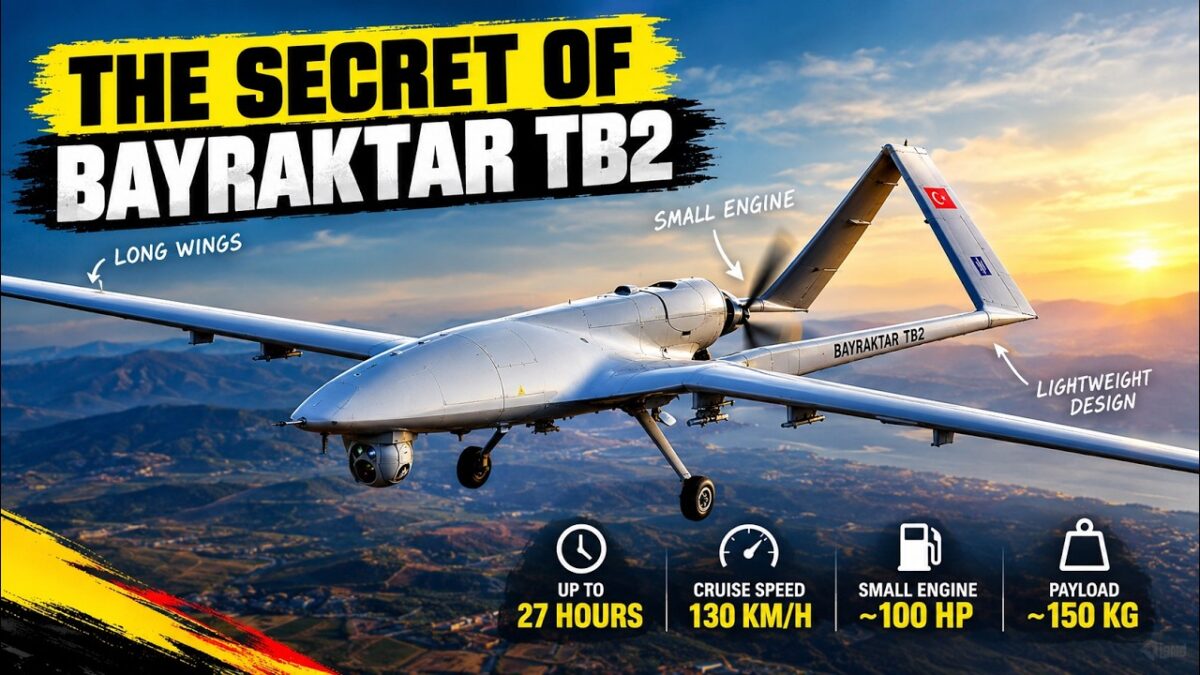
A front-line fighter jet burns tons of fuel and usually returns to base within a few hours. Yet the Turkish-built Bayraktar TB2 can stay airborne for more than a day, cruising at roughly 130 km/h on a single piston engine of about 100 horsepower — the kind of engine you might find in a light civilian airplane.
How can an aircraft that flies slower than a car on the highway outlast a multimillion-dollar fighter by twenty hours or more? The answer is not a miracle engine. It is aerodynamic triage and radical weight discipline. This is the engineering of the Bayraktar TB2.
Watch the Full Documentary
Endurance Is About Drag, Not Power
An aircraft’s endurance depends on how much fuel it carries and how quickly it burns it. Fighters are designed for speed and maneuverability, which demands powerful engines and short, swept wings that create high drag at low speeds. The TB2 is designed for the opposite: loitering slowly for as long as possible with minimal fuel burn.
Glider Wings
The TB2 uses long, slender, high-aspect-ratio wings — long relative to their width, like a glider. At low speeds, much of an aircraft’s drag comes from induced drag, created by the wingtip vortices that form as the wing generates lift. Long, narrow wings spread the lift over a greater span and weaken those vortices, cutting induced drag substantially. That lets the drone stay aloft with very little thrust.
Weight Discipline
Every kilogram saved is fuel that can be carried instead, or fuel that does not need to be burned. Without a cockpit, the TB2 eliminates seats, canopy, oxygen systems, displays and armor. Its fixed landing gear avoids heavy retraction mechanisms. The airframe uses composite materials that are light and strong. The result is an aircraft with a maximum takeoff weight of around 700 kg — tiny compared with crewed combat aircraft.
The Pusher Propeller
The TB2’s propeller is mounted at the rear, pushing rather than pulling. This keeps the airflow over the fuselage and wings cleaner, improving efficiency, and leaves the nose free for sensors. It also places the engine away from the camera turret, reducing vibration in the imagery.
Sensors and Weapons
Under the nose hangs an electro-optical and infrared camera ball for surveillance and laser designation. The drone can carry small guided munitions such as the MAM-L, giving it a strike capability. That combination — long endurance plus precision strike at low cost — made the TB2 famous in conflicts from Libya and Syria to Nagorno-Karabakh and Ukraine.
The Hard Limits
The TB2’s strengths are also weaknesses. It is slow, flies at medium altitude and is vulnerable to modern air defenses and jamming. Its main data link is line-of-sight, limiting its range from ground control stations unless relays are used. Against well-defended opponents with layered air defense, TB2 losses have been significant.
Key Facts at a Glance
- Manufacturer: Baykar, Turkey
- Engine: single piston engine, about 100 hp
- Cruise speed: about 130 km/h
- Endurance: more than 24 hours
- Key design features: high-aspect-ratio wings, pusher propeller, light composites
The American Comparison
The U.S. MQ-1 Predator pioneered this formula in the 1990s, also using a long wing and pusher propeller. The TB2 brought a similar concept to many countries at a much lower price, reshaping the global drone market.
Frequently Asked Questions
How much does a Bayraktar TB2 cost?
Reported prices are in the low millions of dollars per aircraft, far less than most crewed combat aircraft.
Can the TB2 be shot down easily?
Against modern air defenses, yes; it is most effective where air defenses are weak.
Which countries use the TB2?
More than 30 countries, including Turkey, Ukraine, Poland and Azerbaijan.
Grand Structures explains the engineering, defense technology and megaprojects shaping the Middle East and the world. For more deep dives like this, subscribe to Grand Structures on YouTube.