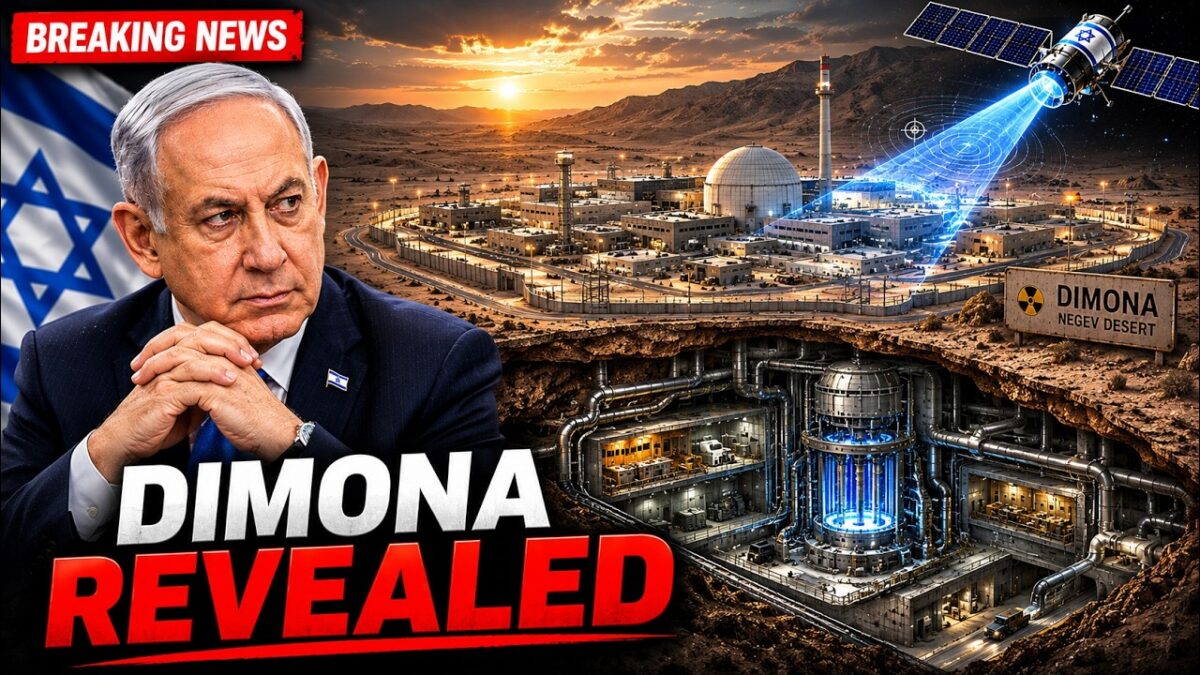
Deep in the Negev desert, about 8 miles from the town of Dimona, sits an industrial complex with no public street map, no tourist signs and a skyline dominated by a single silver dome. Officially it is the Shimon Peres Negev Nuclear Research Center. To most of the world it is simply Dimona — the reactor that has been humming under the desert sun since the early 1960s.
Israel has never officially confirmed what happens inside, and it maintains a long-standing policy of nuclear ambiguity. This article sets that debate aside and looks at a question that is easier to answer from public sources: what does it take, from an engineering standpoint, to build and operate a heavy-water research reactor in one of the harshest climates on Earth?
Watch the Full Documentary
A Reactor Built Far From Everything
Construction began in the late 1950s with French technical assistance. The site choice was deliberate. The northern Negev is sparsely populated, flat enough for large foundations, and far from Israel’s dense coastal cities. Distance offers a safety buffer, simplifies security and keeps the facility away from the country’s main population centers.
But distance also means the facility must be almost entirely self-sufficient. Water, power, spare parts, specialized staff and emergency services all have to be brought in or built on site.
How a Heavy-Water Reactor Works
Dimona is widely described as a heavy-water–moderated reactor. In any fission reactor, neutrons released by splitting uranium atoms must be slowed down so they can trigger more fissions. Ordinary “light” water does this but also absorbs many neutrons. Heavy water, in which hydrogen is replaced by deuterium, absorbs far fewer — which means a reactor can run on natural, unenriched uranium.
That design choice was attractive for a young country with no enrichment industry. The trade-off is that heavy water is expensive, must be carefully contained, and requires precise chemistry control throughout the reactor’s life.
Pouring Concrete in a Desert Oven
The Negev swings from scorching days to cold nights. For massive reactor-grade concrete, that temperature swing is a real threat. As thick concrete cures it generates its own heat; if the core stays hot while the surface cools quickly at night, the difference can crack the structure from the inside.
Engineers counter this with techniques used on large dams: pouring in controlled lifts, cooling the mix with chilled water or ice, scheduling pours for cooler hours, and curing under insulated covers. Containment and shielding structures must stay crack-free for decades because they are part of the radiation barrier.
Cooling Without a River
Most nuclear plants sit beside rivers, lakes or the sea because they need enormous amounts of cooling water. Dimona has none of those. Its relatively modest research-reactor output means it can rely on closed-loop cooling and cooling towers rather than once-through river water — but in a desert, every liter lost to evaporation has to be replaced. Redundant pumps, backup power and multiple cooling paths are essential so that a single failure never leaves the core without heat removal.
An Aging Machine
A research reactor designed in the 1950s was never expected to run indefinitely. Over the decades, reports have pointed to the challenges of aging: radiation-induced embrittlement of metal components, wear on pumps and valves, and the need for continuous inspection. Satellite images in recent years have also shown large new construction at the site, which analysts link to long-term modernization.
A Town Built for a Workforce
The nearby town of Dimona grew alongside the facility, providing housing, schools and services for engineers, technicians and their families. It is a classic pattern for remote megaprojects — from American national laboratories like Los Alamos and Oak Ridge to mining towns in Australia — where infrastructure for people is as important as infrastructure for machines.
Key Facts at a Glance
- Location: northern Negev desert, near the town of Dimona
- Operational since: early 1960s
- Reactor type: widely described as heavy-water moderated
- Main engineering challenges: desert concrete curing, cooling without a river, long-term aging
Frequently Asked Questions
Is Dimona a power plant?
No. Israel has no nuclear power stations. Dimona is a research reactor complex, not a commercial electricity plant.
Can the public visit Dimona?
No. It is one of the most tightly secured sites in Israel, and airspace above it is restricted.
Why does it matter to the United States?
Dimona has been part of U.S.–Israel diplomacy since the Kennedy administration, and it remains central to every discussion about nuclear weapons and nonproliferation in the Middle East, including debates over Iran.
Whatever one thinks of its purpose, Dimona is a remarkable case study in building high-stakes infrastructure where nature offers almost nothing to work with.
Grand Structures explains the engineering, defense technology and megaprojects shaping the Middle East and the world. For more deep dives like this, subscribe to Grand Structures on YouTube.