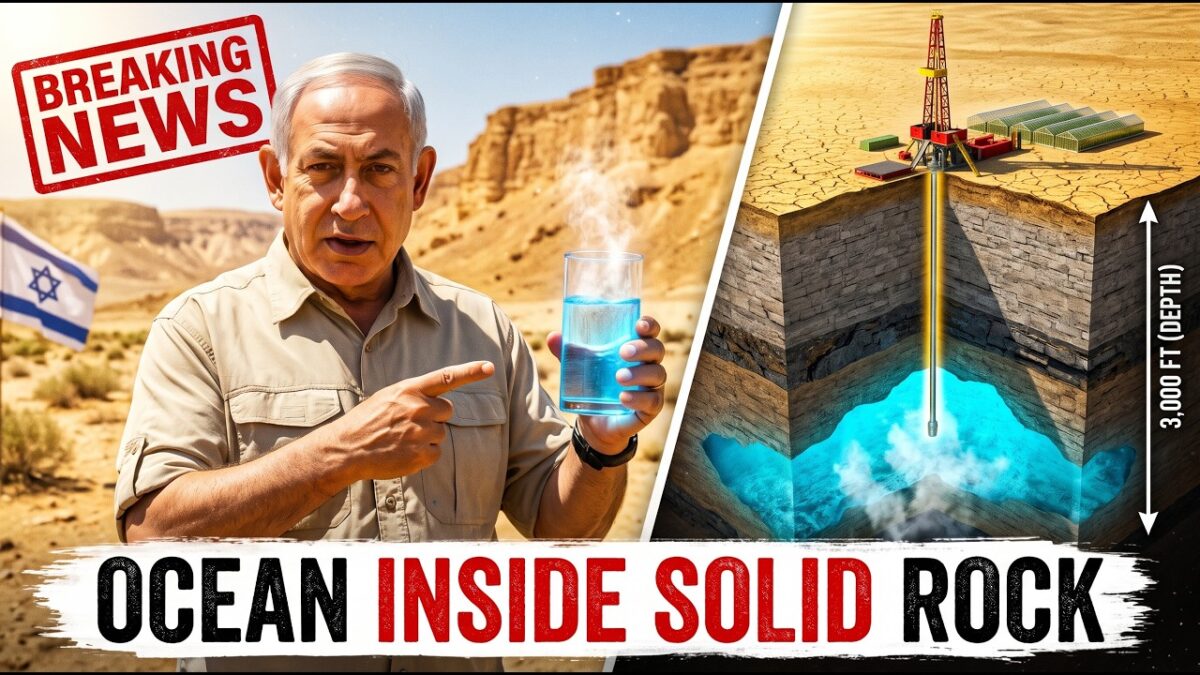
In the Arava Valley and the southern Negev, less than one inch of rain falls in a typical year, summer temperatures climb past 115°F, and there is not a single permanent river or freshwater lake. Yet in the middle of this bone-dry landscape stand rotary drilling rigs of the kind built to hunt oil in Texas, hammering 3,000 feet straight down into solid stone. They are not looking for oil. They are looking for water — and they find it.
Nearly a kilometer below the surface lies the Nubian Sandstone Aquifer, one of the largest fossil-water reservoirs on Earth. It is a prehistoric “stone sponge” that has held its water under enormous pressure since the last Ice Age. This is the story of how Israel reaches that hidden ocean, and why it matters to a country where every drop of water supply is a strategic asset.
Watch the Full Documentary
What Is the Nubian Sandstone Aquifer?
The Nubian Sandstone Aquifer System stretches beneath parts of Egypt, Libya, Sudan, Chad and the Sinai, with its eastern edge running under Israel’s Negev and Arava. The water inside it did not fall last winter. Much of it seeped into porous sandstone tens of thousands of years ago, when North Africa and the Levant were far wetter than they are today, and was then sealed beneath thick layers of impermeable rock.
In Israel, that water sits beneath roughly a kilometer of hard Cenomanian dolomite, fractured limestone and bands of razor-sharp flint. It is locked under about 90 bar — roughly 1,300 PSI — of natural pressure. In practical terms, the reservoir is huge: estimates for the wider system run to hundreds of billions of cubic meters of stored water. But it is also non-renewable on any human timescale, which shapes every engineering and policy decision about how it is used.
Problem One: Drilling 3,000 Feet Through Flint
The first challenge is simply getting there. Chert and flint nodules are glass-hard and brittle. A drill bit that hits them at the wrong speed can chip, overheat or shatter, and a kilometer-long steel drill string can twist and snap like a spring under the torque. Crews manage this with careful control of weight on bit, rotation speed and drilling-mud circulation, which cools the bit, carries rock chips to the surface and keeps the borehole walls from collapsing.
As the well deepens, it is lined with steel casing in stages, each one cemented in place to isolate shallow, lower-quality layers from the deep aquifer. The result is a telescoping steel tube that can survive decades of high pressure and heat.
Problem Two: Water That Fights Back
When the drill finally breaks into the sandstone, the water does not politely wait to be pumped. Under its natural pressure it surges upward. And this is not crisp spring water. Deep Nubian water can arrive at around 140°F (60°C), carrying roughly 4,000 parts per million of dissolved salts and hydrogen sulfide — the gas that smells like rotten eggs and aggressively corrodes ordinary steel.
That chemistry forces engineers to use corrosion-resistant materials, cooling towers or heat exchangers to bring the temperature down, and treatment systems to strip out the gas. Because the water is brackish rather than fresh, it typically passes through brackish-water reverse osmosis — a lower-pressure cousin of the seawater desalination plants on Israel’s Mediterranean coast — before it can be used for drinking or high-value agriculture.
Problem Three: Using a Resource That Does Not Refill
Pumping fossil water is closer to mining than to farming. Every cubic meter withdrawn is effectively gone. That is why Israel treats deep aquifers as a strategic reserve that complements, rather than replaces, its other sources: desalinated seawater, recycled wastewater and the National Water Carrier. Water managers track pressure and salinity in monitoring wells to avoid drawing the reservoir down too fast or pulling saltier water into the wellfield.
Key Facts at a Glance
- Depth: about 3,000 feet (915 meters) below the desert floor
- Rock above it: dolomite, fractured limestone and flint
- Natural pressure: roughly 90 bar (about 1,300 PSI)
- Water temperature: around 140°F (60°C) at the wellhead
- Salinity: roughly 4,000 ppm, requiring treatment before most uses
Why It Matters Beyond Israel
For American readers, this is not an exotic problem. The Ogallala Aquifer under the Great Plains and the deep basins of the Southwest face the same basic question: how do you use ancient groundwater without exhausting it? Israel’s approach — treat deep water as a reserve, desalinate aggressively, and recycle almost everything — is one of the most studied models for a drying American West and for cities that depend on the Colorado River.
Frequently Asked Questions
Does Israel get most of its drinking water from aquifers?
No. Today, large seawater desalination plants supply most of Israel’s household drinking water, with aquifers, the Sea of Galilee and recycled water filling other roles.
Is the Nubian Sandstone Aquifer renewable?
Not in any practical sense. Recharge is extremely slow compared with how fast modern wells can pump, so the water is treated as a finite reserve.
Why is the water so hot?
Rock temperature rises with depth. At roughly a kilometer down, the natural geothermal gradient alone is enough to heat groundwater to around 60°C.
Israel’s hidden ocean is a reminder that in the desert, the most valuable infrastructure is often invisible — buried a kilometer down, under rock that took millions of years to form.
Grand Structures explains the engineering, defense technology and megaprojects shaping the Middle East and the world. For more deep dives like this, subscribe to Grand Structures on YouTube.