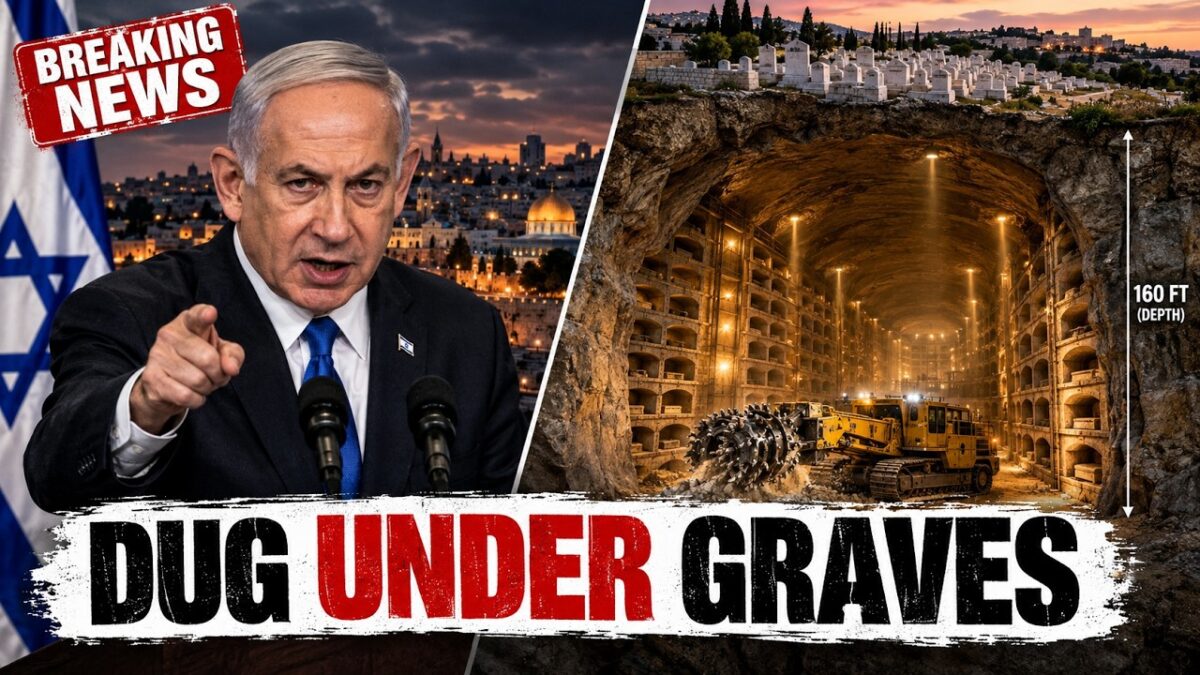
On the western edge of Jerusalem, the city’s largest cemetery — Har HaMenuchot — holds nearly a quarter of a million graves. It is also running out of land. Expanding outward meant cutting into protected hillsides, and building tall above-ground burial towers clashed with land limits and with traditional Jewish burial customs that call for interment in the earth.
So engineers took a radical path. They went about 160 feet straight into the heart of the mountain and carved an underground necropolis — a roughly $77 million network of tunnels and caverns lined with burial niches. It is one of the most unusual civil engineering projects in Jerusalem underground, and a glimpse of how dense cities may handle burial in the future.
Watch the Full Documentary
An Old Idea, Rebuilt With Modern Tools
Burial in rock-cut caves has deep roots in the region. Ancient Jerusalem is surrounded by tombs carved into limestone hillsides, and the catacombs of Beit She’arim in the Galilee are a UNESCO World Heritage Site. The modern project revives that tradition at industrial scale, satisfying religious authorities that burial inside natural rock counts as burial in the earth.
Five Times the Density
By stacking burial niches in tall cavern walls, the underground complex achieves roughly five times the density of surface burial — up to around 6,000 spaces per acre of footprint. The caverns can be as tall as about 52 feet, with multiple levels of niches reached by elevators and walkways. The result preserves the landscape above while adding tens of thousands of burial places for decades to come.
Why Not Just Blast It?
Drill-and-blast tunneling is fast and cheap, but explosions send shockwaves through the rock. Directly above the work sat an active cemetery full of graves, and nearby were roads and buildings. Heavy vibrations were unacceptable. Instead, crews relied mainly on roadheaders — tracked machines with rotating cutting heads on a boom that grind away rock gradually. Roadheaders are slower but far gentler, and they can shape tunnels precisely.
Holding Up a Mountain
The rock here is fractured dolomitic limestone. It is strong in compression, but blocks can loosen along joints. To stabilize the large caverns, engineers installed patterns of steel rock bolts that pin the outer layers of rock to the solid mass behind them, then sprayed reinforced shotcrete over the surface. Arched roofs help channel loads around the openings, much like a stone bridge.
Top-Down Bench Excavation
Excavating a 50-foot-tall cavern raises a practical problem: how do machines reach the ceiling? The answer was top-down bench excavation. Crews first dig and support the top section of the cavern, then lower the floor in successive “benches,” installing wall support as they go. Each level becomes the working platform for the next, eliminating the need for towering scaffolding.
Designing for Visitors
Unlike a typical tunnel, this one must serve grieving families. That means lighting, ventilation, accessibility, wayfinding and dignified architecture. The entrance halls and corridors are finished in Jerusalem stone, and air handling systems keep the environment cool and dry year-round.
Key Facts at a Glance
- Location: Har HaMenuchot cemetery, western Jerusalem
- Depth: about 160 feet (50 meters) into the mountain
- Cost: roughly $77 million
- Density: about five times that of surface burial
- Excavation: roadheaders, rock bolts and reinforced shotcrete
Could This Happen in the U.S.?
Cities like New York and San Francisco face severe cemetery shortages. Mausoleums and vertical cemeteries exist, but underground rock burial at this scale is rare. Jerusalem’s project offers a working model for land-constrained cities.
Frequently Asked Questions
Is the Jerusalem underground cemetery open?
Yes. The first sections opened for burials in recent years, with more planned.
Is underground burial accepted in Jewish law?
Leading rabbinical authorities approved the design because burial takes place within natural rock.
Why not build burial towers?
Towers raised religious objections and visual concerns; the tunnels avoid both.
Grand Structures explains the engineering, defense technology and megaprojects shaping the Middle East and the world. For more deep dives like this, subscribe to Grand Structures on YouTube.