In Haifa, Mount Carmel rises about 1,800 feet straight up from the Mediterranean, squeezing the city’s downtown onto a narrow coastal strip while neighborhoods climb the steep slopes above. For decades, getting from one side of the city to the other meant a 30- to 50-minute crawl around the coast or over winding mountain streets.
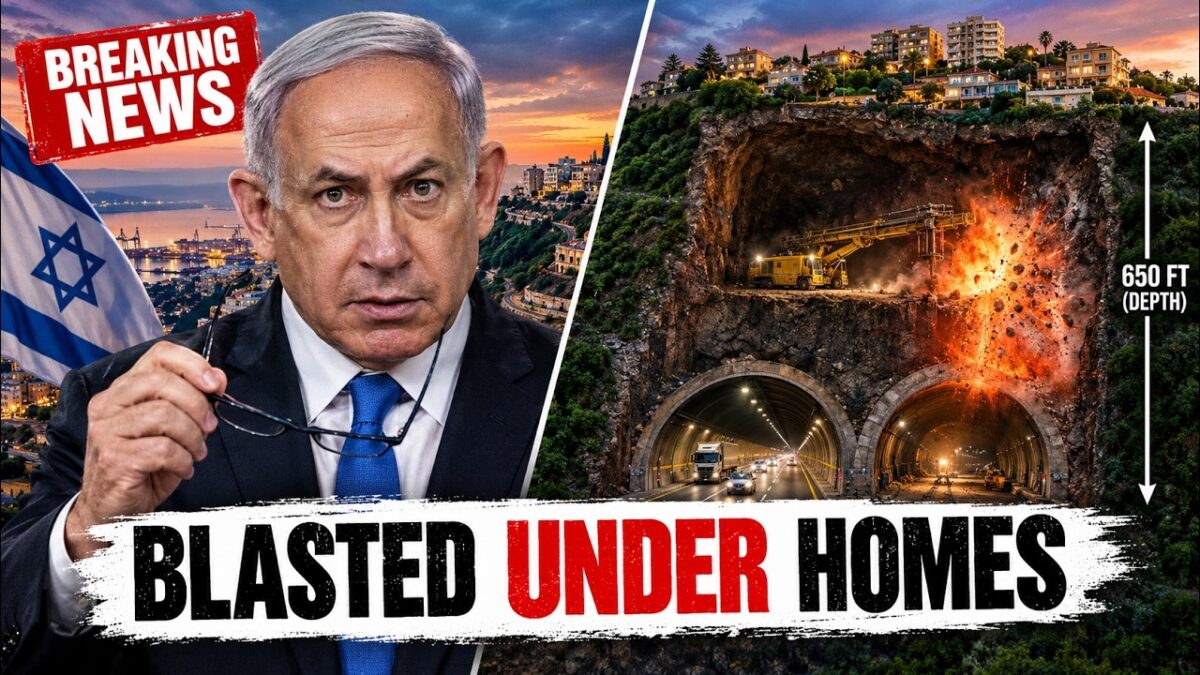
Then engineers drilled straight through the mountain. The Carmel Tunnels — four highway tubes running up to roughly 650 feet below living neighborhoods — cut that trip to about six minutes. Here is how a roughly $300 million tunnel project was built under people’s homes without shaking them apart.
Watch the Full Documentary
Why Not Use a Tunnel Boring Machine?
Tunnel boring machines (TBMs) are ideal for long, uniform tunnels with a constant circular profile. The Carmel Tunnels were the opposite. They are two pairs of tubes, about 4 miles in total, with changing cross-sections, ramps and an underground junction. The rock also varies sharply — hard limestone and dolomite in places, weak volcanic tuff and fault zones in others. A single TBM would have been expensive to mobilize, hard to adapt and risky in the weak zones. Instead, crews used the flexible drill-and-blast method.
Thousands of Blasts Under Homes
Drill-and-blast tunneling advances in short rounds: drill a pattern of holes in the rock face, load them with explosives, detonate, ventilate, remove the broken rock and install support. On the Carmel project this cycle was repeated thousands of times, directly beneath homes, schools and roads.
To keep vibrations within strict limits, engineers used delay detonators that fire charges in a precise sequence milliseconds apart, so the energy is spread out rather than released in a single shock. Seismographs on the surface monitored every blast, and charge sizes were adjusted as the tunnels passed under sensitive buildings.
Crumple Zones for Weak Rock
Where the tunnels crossed weak volcanic tuff, the rock did not simply stand on its own. Under hundreds of feet of overburden, soft rock “squeezes” inward over time. A rigid lining would crack. So engineers used a technique similar to a car’s crumple zone: sprayed-concrete (shotcrete) linings with deliberate slots and deformable elements that let the rock converge a controlled amount, relieving pressure before the final lining was installed. This approach draws on the New Austrian Tunneling Method, which treats the surrounding rock as part of the support system.
An Interchange Inside the Mountain
One of the most unusual features is the junction in the middle of the mountain, where tunnels connect to a valley and surface roads through a multi-level interchange squeezed into a narrow wadi. Building ramps and bridges in a confined valley without destroying it required careful staging and compact structural design.
Fire Safety Deep Underground
A fire in a highway tunnel is one of the most dangerous scenarios in civil engineering. The Carmel Tunnels use jet fans to control smoke direction, cross-passages between parallel tubes so drivers can escape into the unaffected tunnel, and a 24/7 control center monitoring traffic and air quality.
Key Facts at a Glance
- Location: beneath Mount Carmel, Haifa
- Configuration: two pairs of twin tubes, about 4 miles in total
- Maximum cover: up to roughly 650 feet (200 meters) of rock
- Method: drill-and-blast with flexible shotcrete support
- Time saving: crossings reduced to about 6 minutes
What U.S. Cities Can Learn
American cities from Seattle to Boston have spent billions burying highways. The Carmel Tunnels show that when geology is variable, the “old-fashioned” drill-and-blast method can be faster and more adaptable than a giant TBM, and that a toll-funded concession can deliver an urban tunnel without a decade of delays.
Frequently Asked Questions
Are the Carmel Tunnels toll roads?
Yes. They are operated under a private concession and use electronic tolling.
When did the Carmel Tunnels open?
They opened to traffic in December 2010.
Did residents feel the blasting?
Some vibration was unavoidable, but charges were sequenced and monitored to stay within strict limits.
Grand Structures explains the engineering, defense technology and megaprojects shaping the Middle East and the world. For more deep dives like this, subscribe to Grand Structures on YouTube.