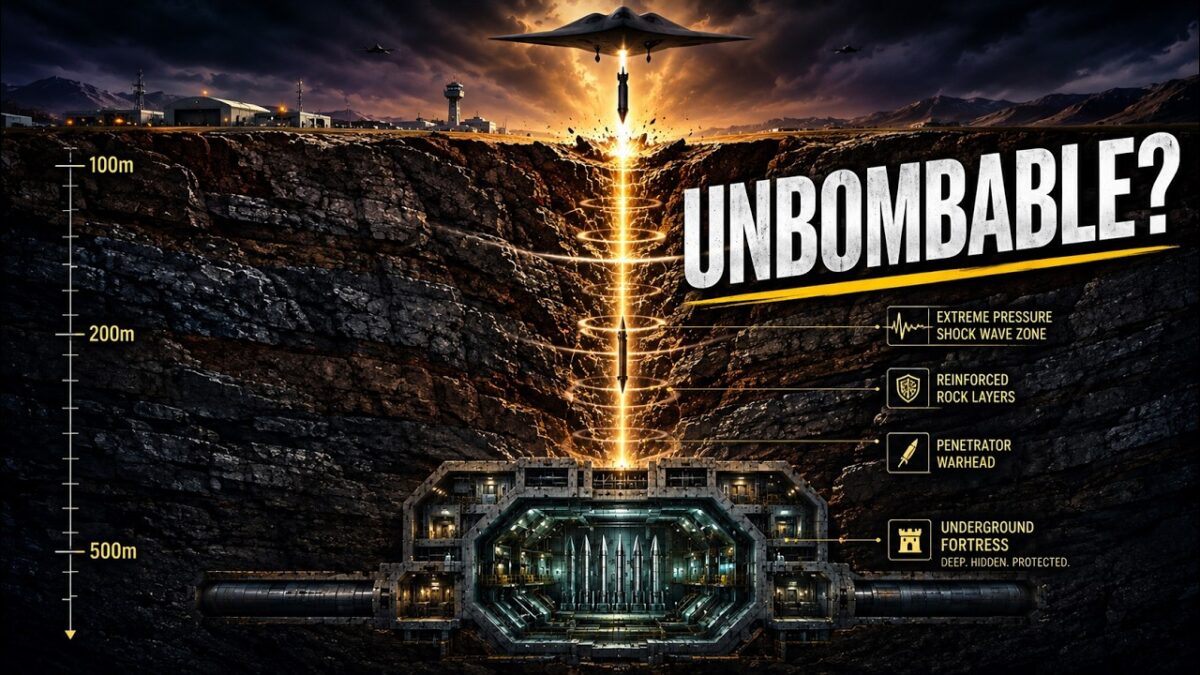
For decades, militaries have relied on a simple formula to survive air strikes: go deeper. Put the command center or missile silo under hundreds of feet of granite, and let geology be the armor. But for every engineer digging a deeper fortress, there is a weapons designer using physics to reach it. The result is a 50-year arms race between the people who bury things and the people whose job is to destroy them.
So can a bunker really be unbombable? The honest answer is: sometimes, against some weapons, for some time. Understanding why requires looking at rock, shockwaves and the surprisingly limited ways a bunker buster bomb can fight depth.
Watch the Full Documentary
Why Granite Is Perfect Armor — Until It Isn’t
Hard crystalline rock like granite has enormous compressive strength, often well above 20,000 PSI. A penetrating weapon that strikes it must spend its kinetic energy crushing and pushing aside that rock, and the deeper it goes, the faster it slows. That is why facilities like NORAD’s Cheyenne Mountain Complex in Colorado or Iran’s Fordow enrichment plant were placed under hundreds of feet of stone.
But rock is not uniform. Faults, joints and weathered zones are weak paths, and every bunker has entrances, ventilation shafts and utility lines that must reach the surface. Those openings — not the rock itself — are often the real vulnerability.
How Bunkers Trap Shockwaves
An explosion near a tunnel entrance sends a blast wave racing down the corridor. A straight tunnel would channel that pressure directly into the facility. So designers build zig-zag or dogleg tunnels, where each sharp turn reflects and weakens the wave. Expansion chambers give the pressure room to dissipate, and heavy blast doors seal key compartments.
Inside, critical rooms may be built as separate structures mounted on huge springs or shock isolators, so that ground shock from a nearby detonation is not transmitted directly to people and equipment. Cheyenne Mountain’s buildings famously sit on more than a thousand steel springs.
The Physics of a Penetrating Bomb
A bunker buster is essentially a very heavy, very hard, very narrow steel case with a relatively small explosive charge. Its job is to convert speed and mass into penetration. The U.S. GBU-57 Massive Ordnance Penetrator weighs about 30,000 pounds and, according to public estimates, can penetrate on the order of 200 feet of moderately hard material before exploding. Against very hard rock, that number drops.
Penetration depth depends on impact velocity, the weapon’s weight per unit of cross-section, its nose shape and the strength of the target. Smart fuzes count the layers or voids the weapon passes through and decide when to detonate.
The Myth of “Drilling” With Repeated Bombs
A popular idea is that you can drop bombs into the same crater, one after another, to drill deeper. In theory it can add depth. In practice, the first explosion fractures and loosens the rock and fills the hole with debris, and the next weapon must hit almost exactly the same point at the right angle. It is possible, and modern precision guidance helps, but it is far harder than it sounds.
Listening to the Mountain
The modern contest is not only about weapons. It is also about knowledge. Intelligence agencies use seismic sensors that pick up machinery vibrations, thermal imaging that spots warm ventilation exhaust, radar satellites that detect tiny ground movements and, increasingly, gravity measurements that can hint at voids underground. Knowing exactly where a hall or shaft is located can matter more than adding another 50 feet of rock.
Key Facts at a Glance
- Best natural armor: hard, unfractured crystalline rock like granite
- Main bunker weak points: entrances, ventilation shafts, power and data lines
- Largest U.S. conventional penetrator: GBU-57 MOP, about 30,000 lb
- Common defenses: dogleg tunnels, blast doors, shock-isolated rooms
Why This Matters Now
The June 2025 strikes on Iran’s nuclear sites put deep bunkers back in the headlines and showed that depth alone is not a guarantee. They also pushed countries to dig deeper and disperse further. For the United States, the lesson cuts both ways: it must maintain weapons that can hold deep targets at risk, while hardening its own command sites against similar attacks.
Frequently Asked Questions
What is the deepest a bunker buster can go?
Public estimates for the GBU-57 suggest roughly 60 meters in moderately hard material, less in very hard rock. Exact performance is classified.
Can a nuclear weapon destroy any bunker?
Even nuclear weapons have depth limits, but a nearby nuclear blast can collapse tunnels and seal entrances, which is why deep bunkers are not considered immune.
Is any bunker truly unbombable?
No bunker is permanently invulnerable. The best ones simply raise the cost and uncertainty of an attack.
Grand Structures explains the engineering, defense technology and megaprojects shaping the Middle East and the world. For more deep dives like this, subscribe to Grand Structures on YouTube.