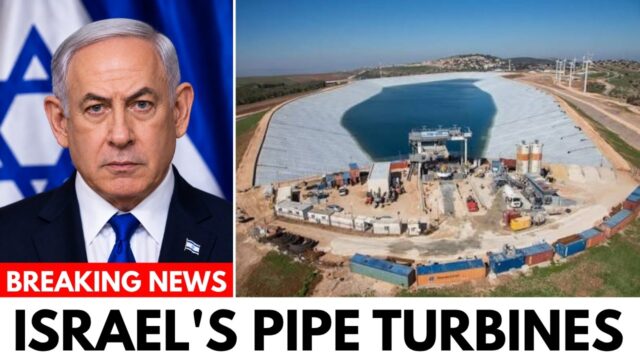
Desalination provides up to 80% of Israel’s drinking water, turning the Mediterranean Sea into a reliable daily source. To keep up with demand, engineers built Sorek 2, also called Be’er Miriam — a roughly $1.5 billion megaproject capable of processing about 670 million liters of water every day. It is often described as one of the largest and most efficient seawater reverse-osmosis plants in the world.
Yet in 2026, a bloom of microscopic algae forced much of Israel’s coastal desalination capacity offline. This article explains the brilliant engineering of Sorek 2, and why the country’s “water Iron Dome” turned out to have a biological Achilles’ heel.
Watch the Full Documentary
How Reverse Osmosis Works at Scale
Reverse osmosis pushes seawater at high pressure — around 60 to 80 bar — through semi-permeable membranes that let water molecules pass while blocking salt. Roughly 45% of the feedwater becomes fresh water; the rest leaves as concentrated brine. At Sorek 2’s scale, this happens in thousands of pressure vessels, each holding several membrane elements, running around the clock.
Tunneling the Intake Under the Beach
A desalination plant needs a huge, steady flow of seawater. Sorek 2 draws water through large intake pipes, about 2.6 meters in diameter, laid beneath the seabed and beach. Instead of digging an open trench across the shoreline, crews used hydraulic pipe jacking: powerful jacks push sections of pipe through the ground from a launch shaft while a cutting head excavates at the front. This protects the beach and avoids disrupting the coast.
Pumps Driven by Steam
Pressurizing seawater consumes most of a desalination plant’s energy. Sorek 2 uses an unusual solution: high-pressure pumps driven directly by steam turbines from a dedicated onsite power plant, rather than by electric motors. Skipping the step of generating electricity and then converting it back to mechanical power reduces losses. Energy recovery devices also capture pressure from the outgoing brine and transfer it back to incoming seawater.
Recycling Carbon Dioxide
Water from reverse osmosis is almost too pure. It lacks minerals and can corrode pipes. Plants add calcium and other minerals back, often using carbon dioxide and limestone. Sorek 2 integrates a remineralization loop that captures CO2 from its power plant exhaust and uses it in this process — turning a waste stream into a useful input.
The Algae Problem
Membranes are extraordinarily fine filters. That makes them vulnerable to anything that clogs them. When warm water and nutrients trigger a bloom of microalgae offshore, intake water becomes loaded with organic material. Pretreatment filters can be overwhelmed, and algae and their sticky byproducts foul membranes quickly. To protect billions of dollars in equipment, operators reduce output or shut down.
In 2026, a large bloom affected the Israeli coast, forcing plants to cut production simultaneously. Because they all draw from the same sea, a single biological event hit nearly the entire system at once — a classic common-mode failure.
How Israel Responds
Water managers draw on stored reserves, the Sea of Galilee and aquifers when desalination drops. Engineers are also upgrading pretreatment with technologies like dissolved air flotation and ultrafiltration, and studying deeper or more distant intakes that are less exposed to surface blooms.
Key Facts at a Glance
- Plant: Sorek 2 (Be’er Miriam), south of Tel Aviv
- Cost: about $1.5 billion
- Capacity: about 670 million liters per day
- Key innovations: pipe-jacked intakes, steam-driven pumps, CO2 remineralization
- Weak point: algae blooms fouling membranes
Lessons for American Water Planners
California, Texas and Arizona are all studying large-scale desalination. Israel’s experience shows that efficiency is only half the story. Resilience — redundant sources, robust pretreatment and storage — matters just as much.
Frequently Asked Questions
How much of Israel’s water comes from desalination?
Up to about 80% of household drinking water, depending on the year.
Why does algae shut down desalination plants?
It clogs filters and membranes, which can be permanently damaged if operation continues.
Did Israel run out of water?
No. Reserves and other sources covered the gap while plants recovered.
Grand Structures explains the engineering, defense technology and megaprojects shaping the Middle East and the world. For more deep dives like this, subscribe to Grand Structures on YouTube.