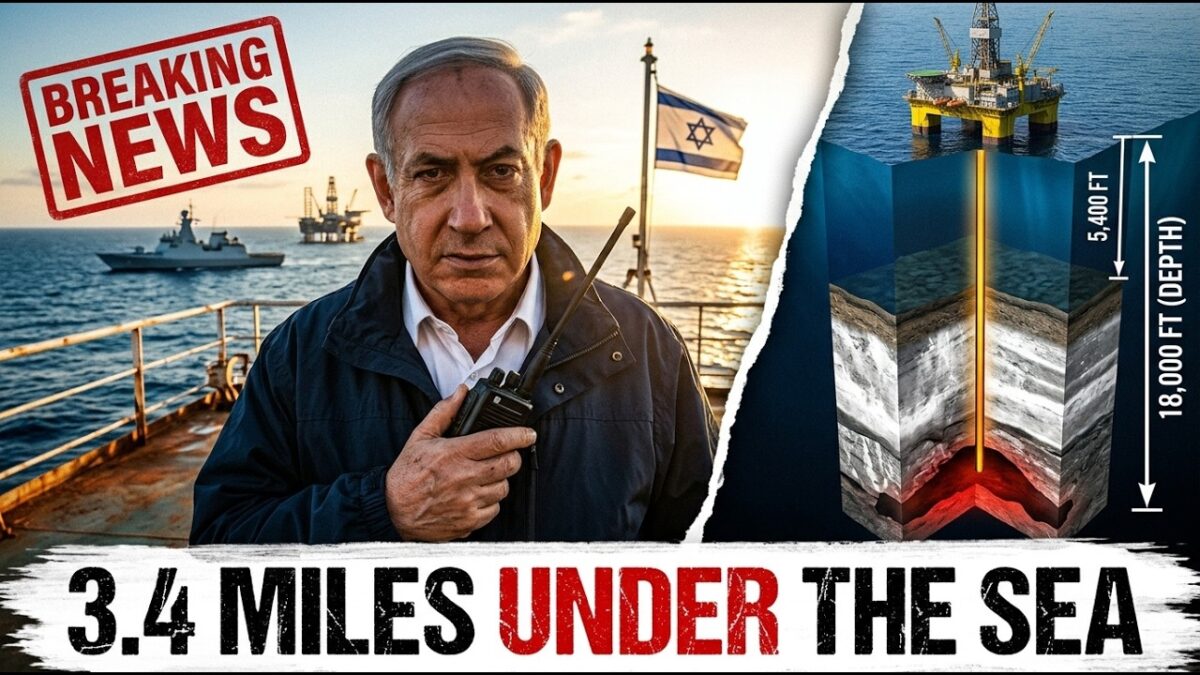
About 80 miles west of Haifa, in the middle of the Mediterranean, the seabed lies more than 5,400 feet below the waves. Under that dark, near-freezing water sits another 12,600 feet of rock — including a layer of salt more than a mile thick — and below all of it is one of the largest offshore gas discoveries of the century: the Leviathan gas field, holding roughly 22 trillion cubic feet of natural gas at around 10,000 PSI.
Reaching it meant drilling about 18,000 feet below sea level, deeper than six Burj Khalifas stacked end to end. This is how the Leviathan gas field went from a seismic survey to the backbone of Israel’s energy system.
Watch the Full Documentary
Drilling From a Ship With No Anchors
In 5,400 feet of water, you cannot build a fixed rig on the seabed to drill exploration and production wells. Instead, crews use dynamically positioned drillships — vessels that hold their position over the well using GPS, satellite references and computer-controlled thrusters, correcting continuously for wind, waves and current. A blowout preventer the size of a small building sits on the seabed, connected to the ship by a riser pipe nearly a mile long.
The Salt Problem
The most treacherous section is the salt. Thick evaporite layers deposited when the Mediterranean nearly dried out millions of years ago behave like an extremely slow fluid under pressure. Salt “creeps” — it flows inward toward the borehole and can squeeze or collapse steel casing like a tin can if the well is not designed for it.
Engineers counter this with heavy, carefully weighted drilling fluids that push back against the salt, thick-walled high-collapse casing, and fast drilling through the salt interval so it has less time to close in. The geology above and below the salt also has very different pressures, which makes casing design one of the most critical parts of the well plan.
“Fire Ice” in the Pipelines
Gas from deep reservoirs comes up hot and wet. As it travels along cold seabed flowlines, water and methane can combine into methane hydrate — an ice-like solid sometimes called “fire ice” — which can block a pipeline completely. To prevent this, Leviathan uses a long chemical-injection system that pumps an antifreeze, typically monoethylene glycol (MEG), from the platform out to the subsea wells and back, lowering the temperature at which hydrates form. The MEG is then recovered and recycled on the platform.
A 42,000-Ton Fortress Near the Coast
Rather than building a floating production vessel far offshore, the operators chose a fixed processing platform in shallower water about 6 miles off the coast. The jacket and topsides together weigh around 42,000 tons and stand roughly 30 stories tall. The subsea wells send raw gas through long pipelines to the platform, where it is treated and then sent to shore and to export customers.
Because it is critical national infrastructure, the platform is protected by the Israeli Navy, including Sa’ar 6 corvettes equipped with the naval C-Dome version of Iron Dome.
Why Leviathan Matters
Before offshore gas, Israel imported most of its fuel for power. Today natural gas from Leviathan and the nearby Tamar field generates the majority of the country’s electricity, and exports to Egypt and Jordan have turned Israel into a regional energy supplier. For U.S. readers, the project is also a story of American engineering and capital: Texas-based Noble Energy led the early discovery and development before being acquired by Chevron, which operates the field today.
Key Facts at a Glance
- Location: about 80 miles (130 km) west of Haifa
- Water depth: about 5,400 feet (1,645 meters)
- Total depth: roughly 18,000 feet below sea level
- Estimated resource: about 22 trillion cubic feet of gas
- Operator: Chevron
Frequently Asked Questions
When did Leviathan start producing gas?
The field began production at the end of 2019, about nine years after its discovery in 2010.
Where does Leviathan gas go?
Mainly to Israel’s power plants, with significant exports by pipeline to Egypt and Jordan.
Has the field ever been shut down?
Yes. Production has been paused for safety during periods of regional conflict, a reminder that energy infrastructure is also a security target.
Leviathan shows how a country with almost no natural resources on land turned a deep-sea gamble into energy independence.
Grand Structures explains the engineering, defense technology and megaprojects shaping the Middle East and the world. For more deep dives like this, subscribe to Grand Structures on YouTube.